Synths, Goblins, and Heavy Metal: Jeff Williams’ Chthonic Chamber
Wells Chandler April 18. 2026
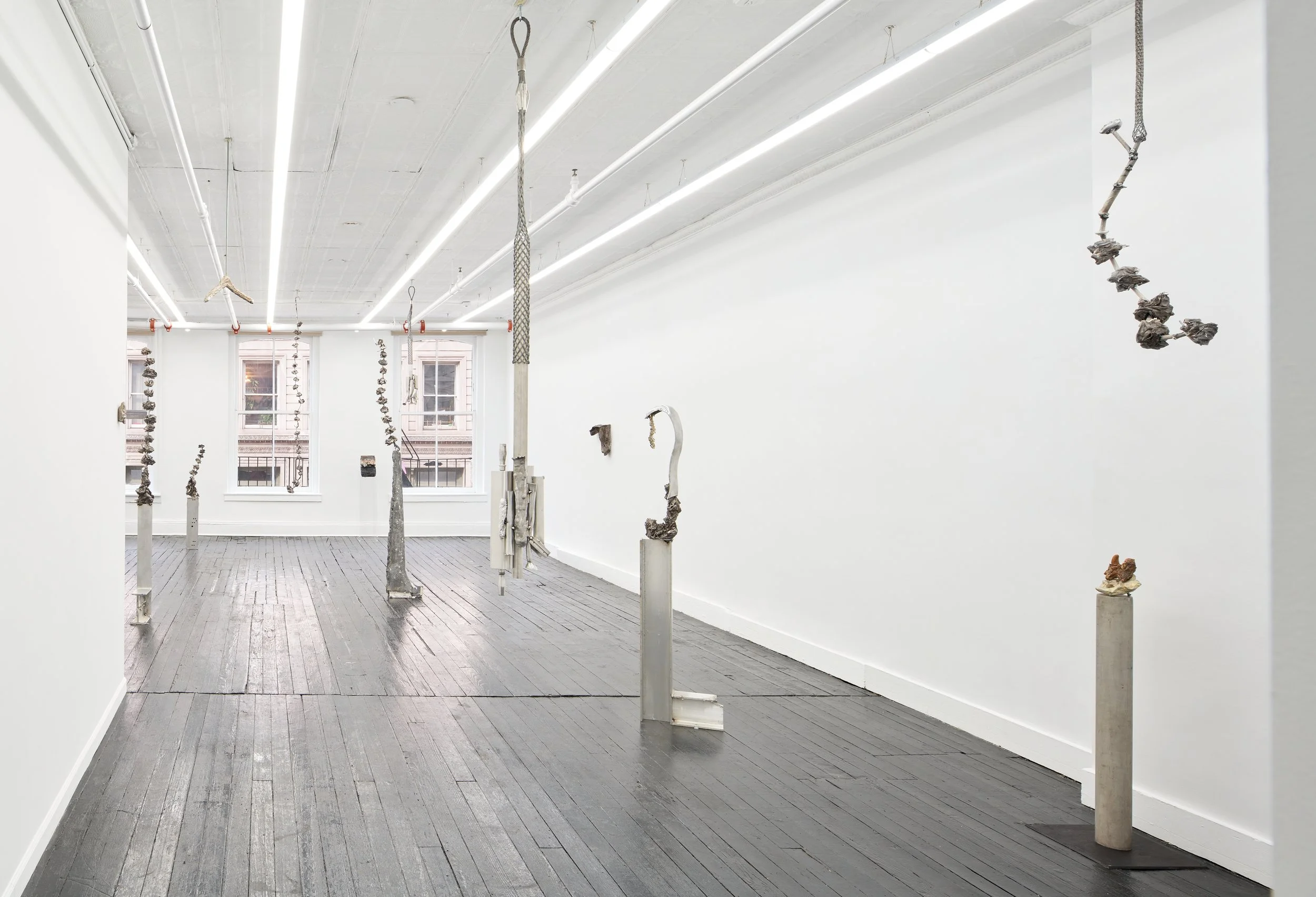
Installation view of Electro Slag at Kate Werble New York, NY (courtesy of the artist and Kate Werble Gallery, photo Brad Farwell)
In Electro Slag, Jeff Williams transforms Kate Werble Gallery into a resonant cavern, an environment where sculpture, language, and duration converge as active agents. His exhibition operates as a field of encounter enacting the conditions of the chthonic chamber. Reality is staged as an ongoing event shaped by the numinous and characterized by opacity. Williams advances into new territory by shifting from an outward orientation to an immersive, acoustic ecology in which echo, the sonic function of the cave, synthesizes the known, knower, and knowing.
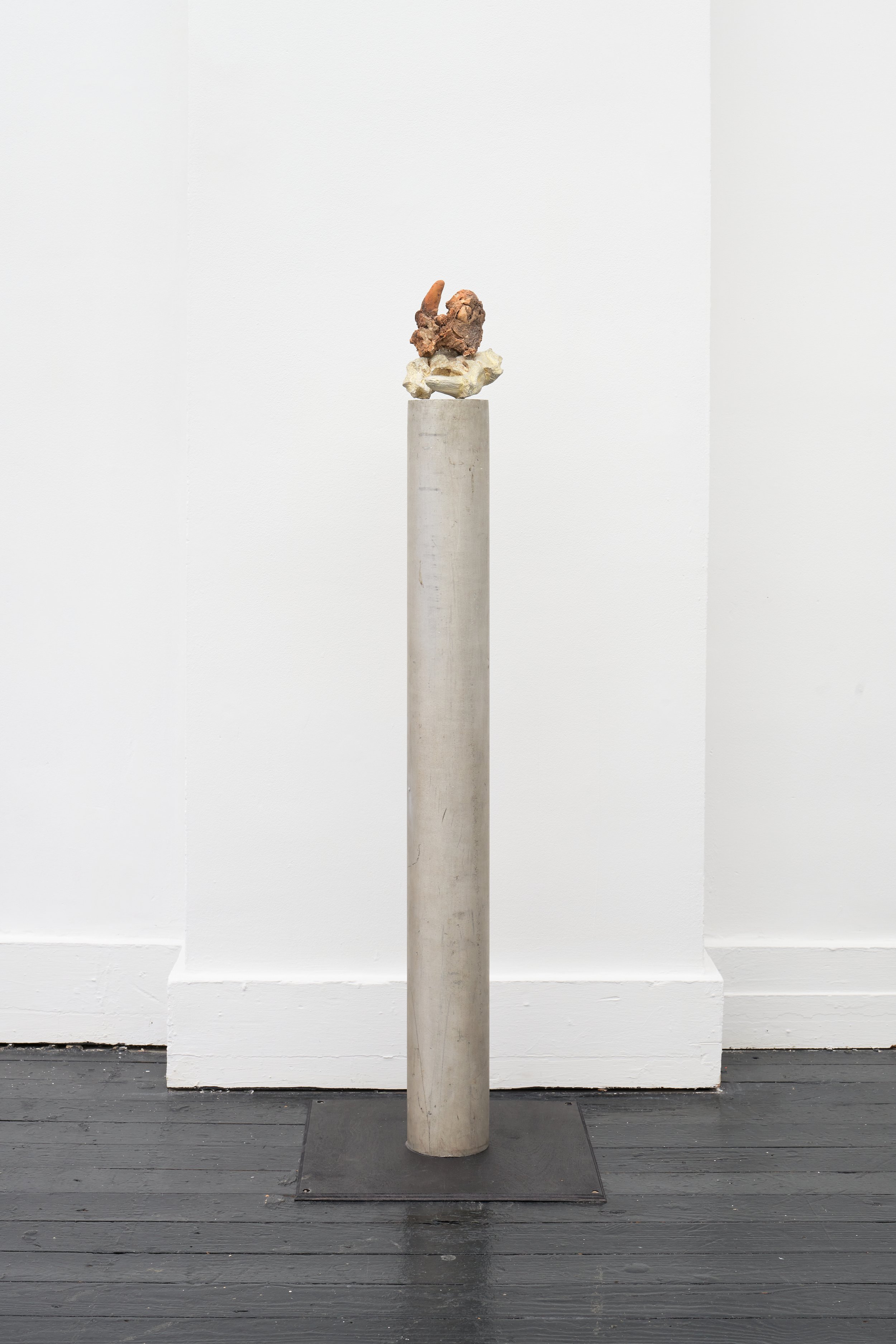
Jeff Williams “Tide Pool” (2025) Fossil with cast pewter 4 × 7 × 3.5 inches (courtesy of the artist and Kate Werble Gallery, photo Brad Farwell)
Buddhist philosophy describes time as an interdependent matrix in which past, present, and future are co-present. In many Mahāyāna interpretations, phenomena arise simultaneously through dependent origination. Accessing the timeless infinity of total darkness requires sensory deprivation, beyond the projection of shadow material. A return to this state is a point of origin. The cave is the ideal invaginating alembic to forge this temporal understanding.
Within this framework, the fossils and speleothems that punctuate Williams’ vocabulary collapse time, embodying this ongoing synchronic process. There are actual fossils and human-made fossils in Electro Slag. Reminiscent of an iron oxide prehistoric tooth, Tide Pool features a 65 million year-old flower bulb fossil supported by cuttlefish bone casted pewter. Simultaneously time capsules, fossils represent the transformation of life into geology. The boundary between organism and environment dissolves, as biological matter is incorporated into the mineral record of the planet, compressing time into carbon.
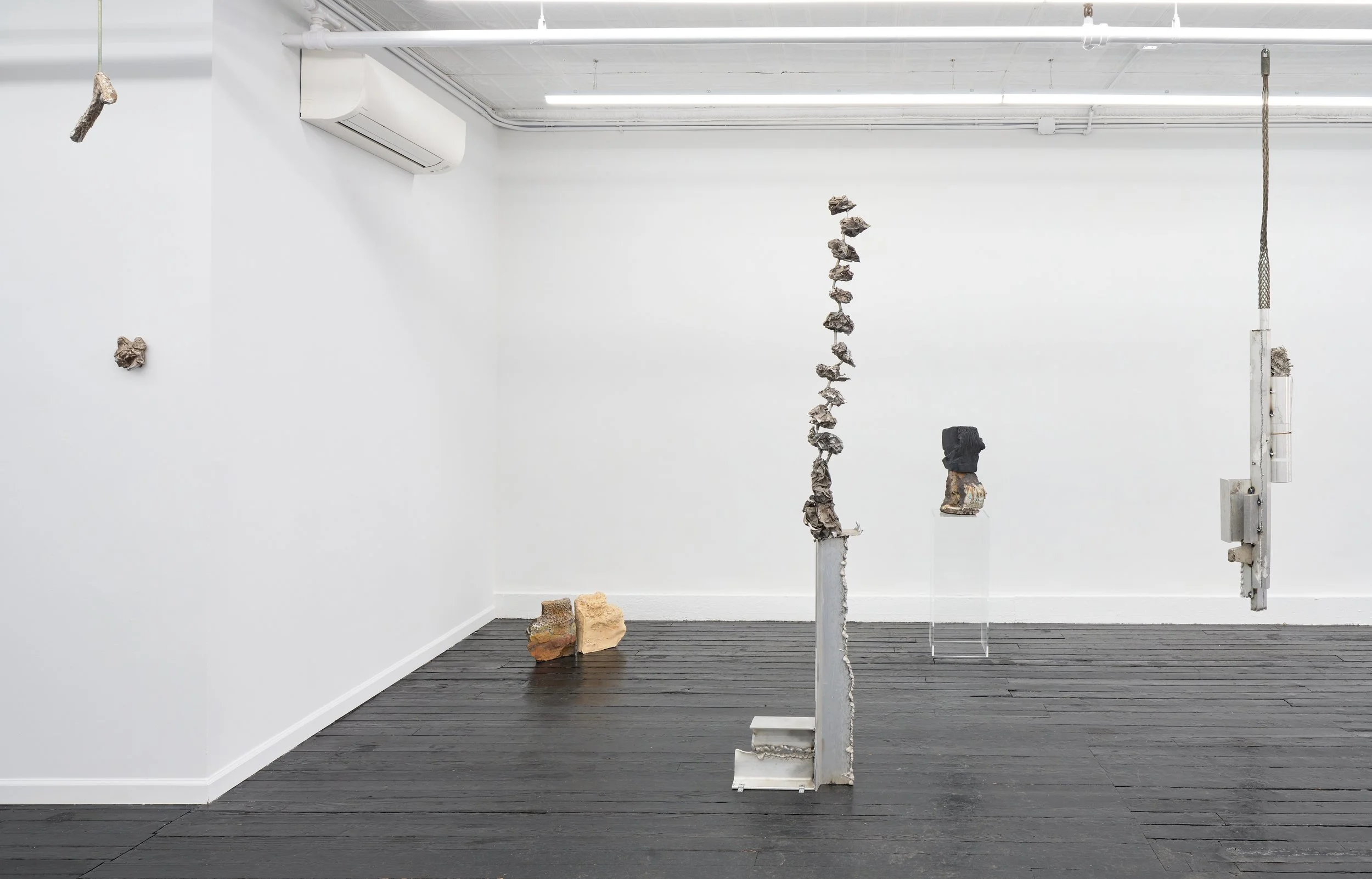
Installation view of Electro Slag at Kate Werble New York, NY (courtesy of the artist and Kate Werble Gallery, photo Brad Farwell)
In Plato’s Allegory of the Cave, the cave is a psychic topology structured by appetite. Desire fixes prisoners to shadows, and the naming of those shadows gives a false stability to what is only projection. To escape this theater of simulacrum and before ascent, one must in a sense move further inward, retreating into the cave’s depths where the limits of naming collapse and the psyche confronts its own generative darkness. This movement echoes Carl Jung’s process of individuation, in which the descent into the unconscious, the alchemical nigredo, precedes illumination. By turning inward beyond the theatre of illusion having transmuted shadow material, the Philosopher King emerges as one who sees the light. They are a figure who embodies the union of opposites and can return to the cave without falling into illusion.
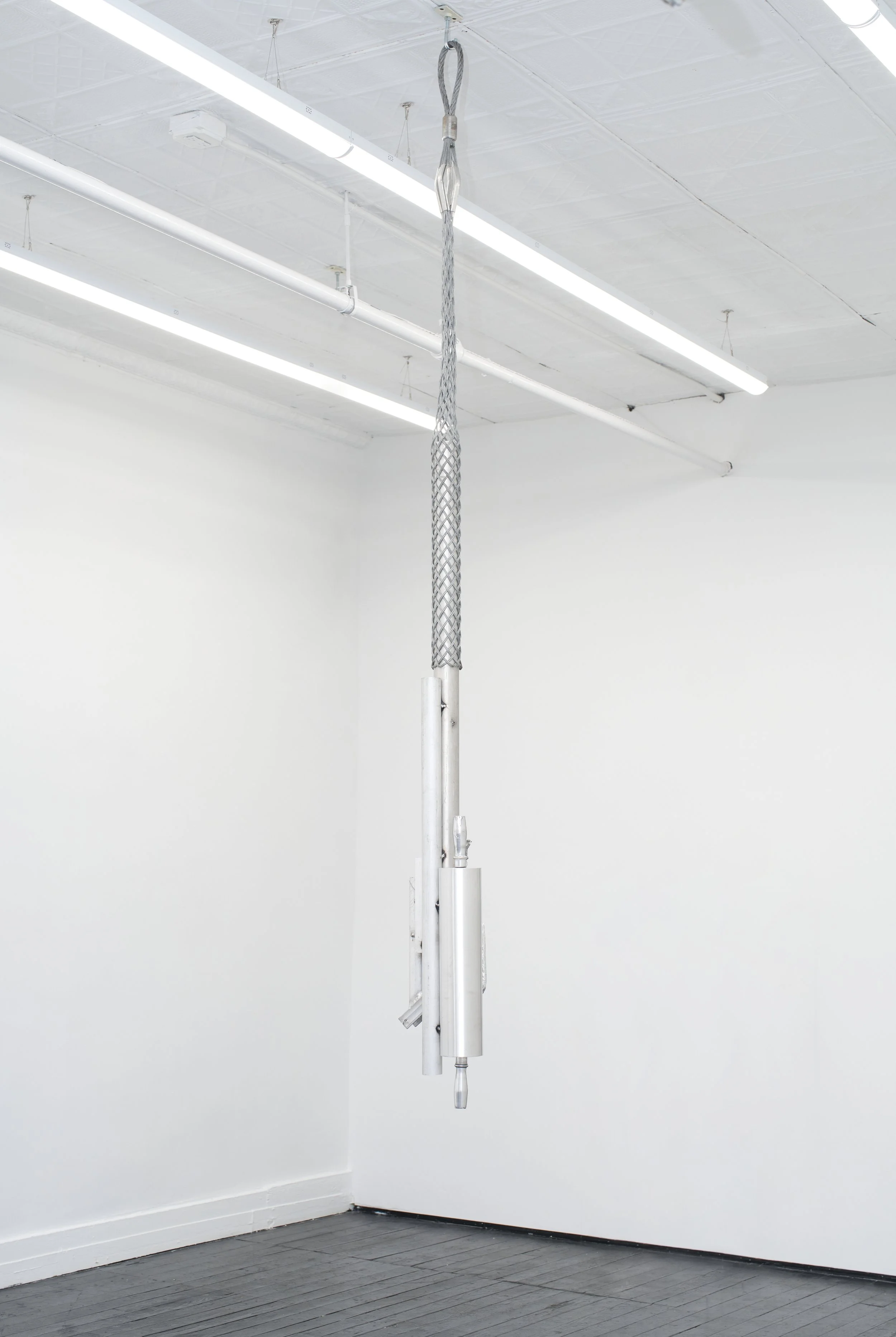
Jeff Williams “Toxic Munchies” (2025) Welded aluminum suspended by a steel mesh grip 100 x 9 x 6 inches (courtesy of the artist and Kate Werble Gallery, photo Brad Farwell)
The titles of the works in Electro Slag are funny. Further continuing Plato’s cave metaphor, many of the sculptures are eponyms of cave formations given by fellow spelunkers, who happen to be deep stoners. Toxic Munchies and Trash the Gardens are such; they fillet opening interpretation. In Williams’ exhibition, the cave is both material and an energetic site where naming falters. The bisected form of Typewriter, a kiln brick mirrored by a squishy latex rubber cast, points to the limitations of language and narrative. Williams’ sculptures resist singular taxonomy. Drawing us into molten interiority, Williams charts an exit from duality. Populated with sculptures suggestive of stalagmites, stalactites and fossils, Williams’ object-oriented ontologies shapeshift. Skeletal remains, dancing dragons, fiery serpents, kundalini energy, DNA strands, the letter S, and goblin sorcery associatively bounce off one another indefinitely. Williams’ heavy metal works conjure the flickering kind of theatre of mercurial images that one experiences from staring into a roaring fire.
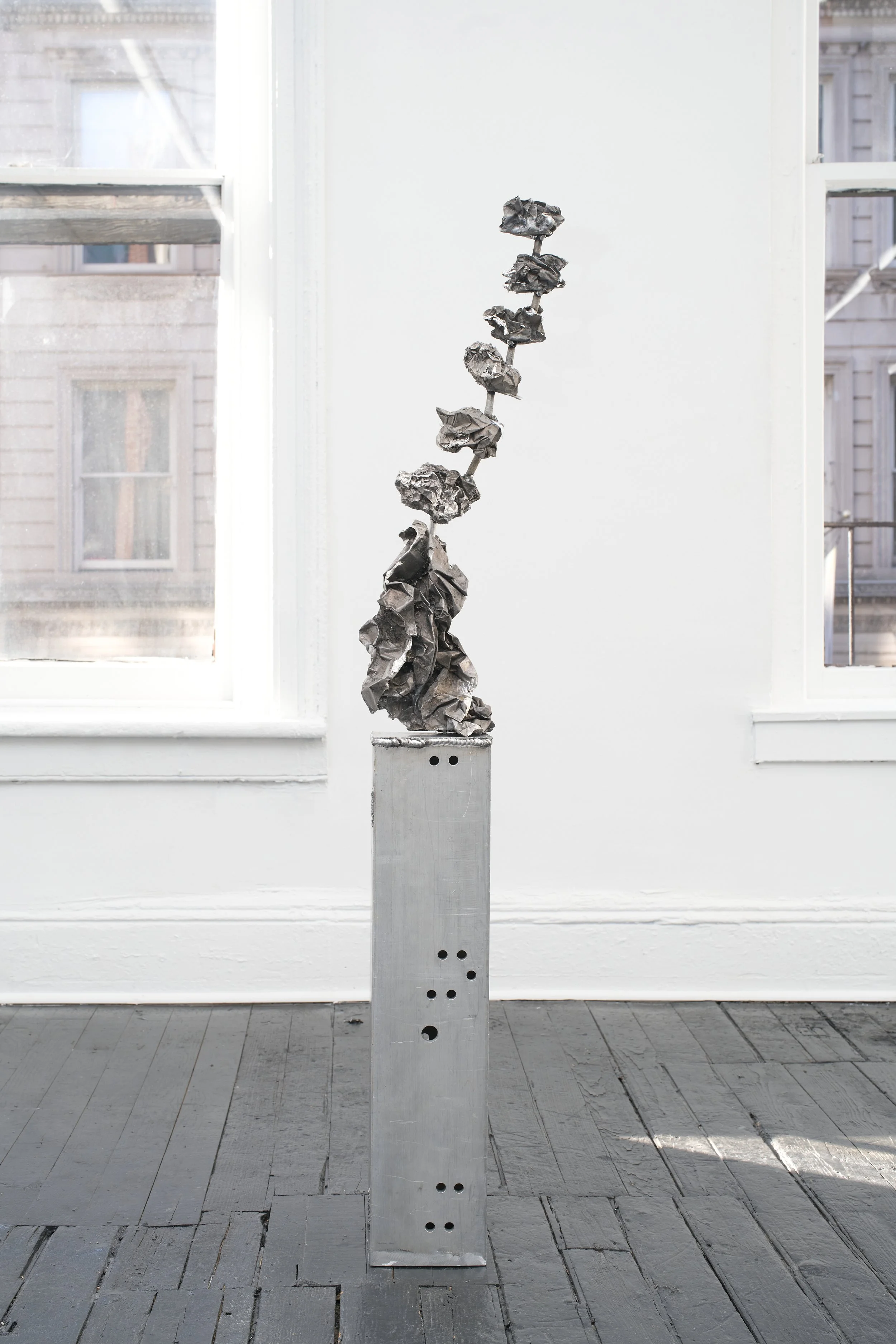
Jeff Williams “Butter Side Up” (2025) Cast and welded aluminum27 × 6 x 6 inches (courtesy of the artist and Kate Werble Gallery, photo Brad Farwell)
Orienting itself differently from previous exhibitions, shadow material is transmuted and filtered through the vulnerability of the body. When we refuse to emphatically claim the nature of reality and turn inward, something shifts. Looking at the dynamic installation of Williams’ work, many questions come to mind. What happens to our experience of reality when we begin to observe the limitations of grasping as a perceptual tool? Crumbled sheets of aluminum squeezed by the hand in Butter Side Up point to this, while absurdly referencing a barbecued carcass picked clean. Pleasure, ritual feast, and community surface as something meaningful to life. What can be learned from surrender? Chinese finger trap pole grips in Small Crush, as well as, Hanging Spine bring to mind The Hanged Man, an initiatory tarot card in the Major Arcana symbolizing voluntary sacrifice, letting go of control, and viewing life from a reversed perspective. The wisdom of middlescence feels present in this work while maintaining a spark of irreverent punkdom. Black gold bubbling beneath, trespassing on ranches in the Texas Hill Country is part of William’s delinquent process. Accompanied by merry pranksters, among them the artist Marie Lorenz, Williams’ partner, they squat in caves to make drawings and forage materials from dinosaur graveyards overrun by mysterious hogs that have yet to be seen.
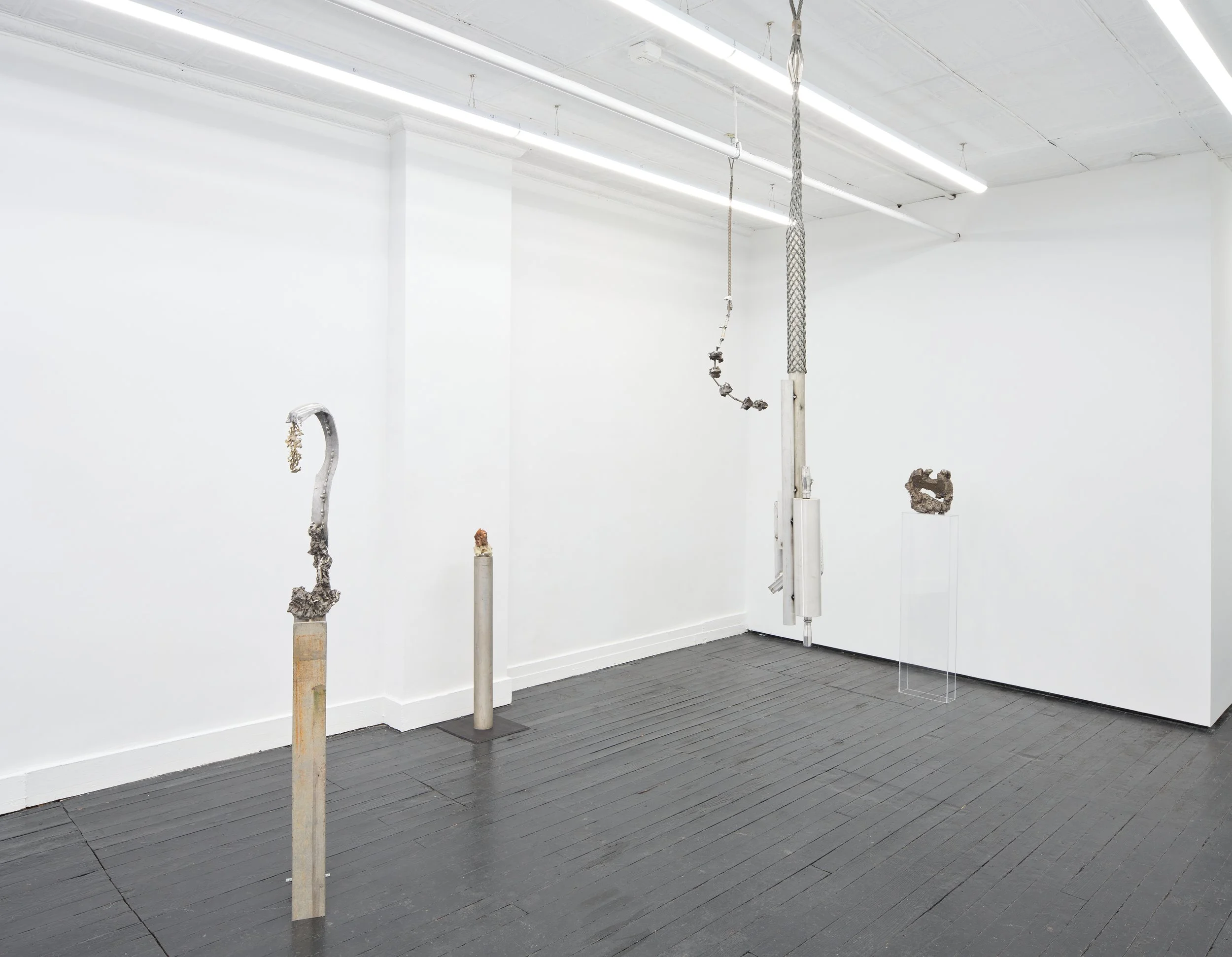
Installation view of Electro Slag at Kate Werble New York, NY (courtesy of the artist and Kate Werble Gallery, photo Brad Farwell)
The historian of religion Mircea Eliade argued that metallurgy and blacksmithing were historically regarded as sacred practices because they replicated the transformative processes of the earth itself. In The Forge and the Crucible, Eliade writes that the metallurgist is “an alchemist before alchemy,” a figure who accelerates geological time by extracting ore from the earth and subjecting it to fire. Embodying both the smith and the alchemist, Williams is a mediator between worlds, working with fire, earth, and metal.
Derived from the red mineral cinnabar, quicksilver is a liquid metal and the traditional name for the chemical element mercury. In alchemy, it is considered one of the three principal substances, alongside salt and sulfur, believed to be the building blocks of all metals. Quicksilver is the foundational, transformative substance representing the spirit. It is the mediating principle between opposites. Quicksilver binds sulfur, the masculine soul, and salt, the feminine body, together. As a solvent, it purifies metals into gold. As a living metal, it represents the volatile, flowing spirit that bridges life and death. Quicksilver is the essential component for creating the Philosopher's Stone: the alchemical elixir of life for immortality, rejuvenation, and healing. It is the metallic color that connects and binds the works in Electro Slag.
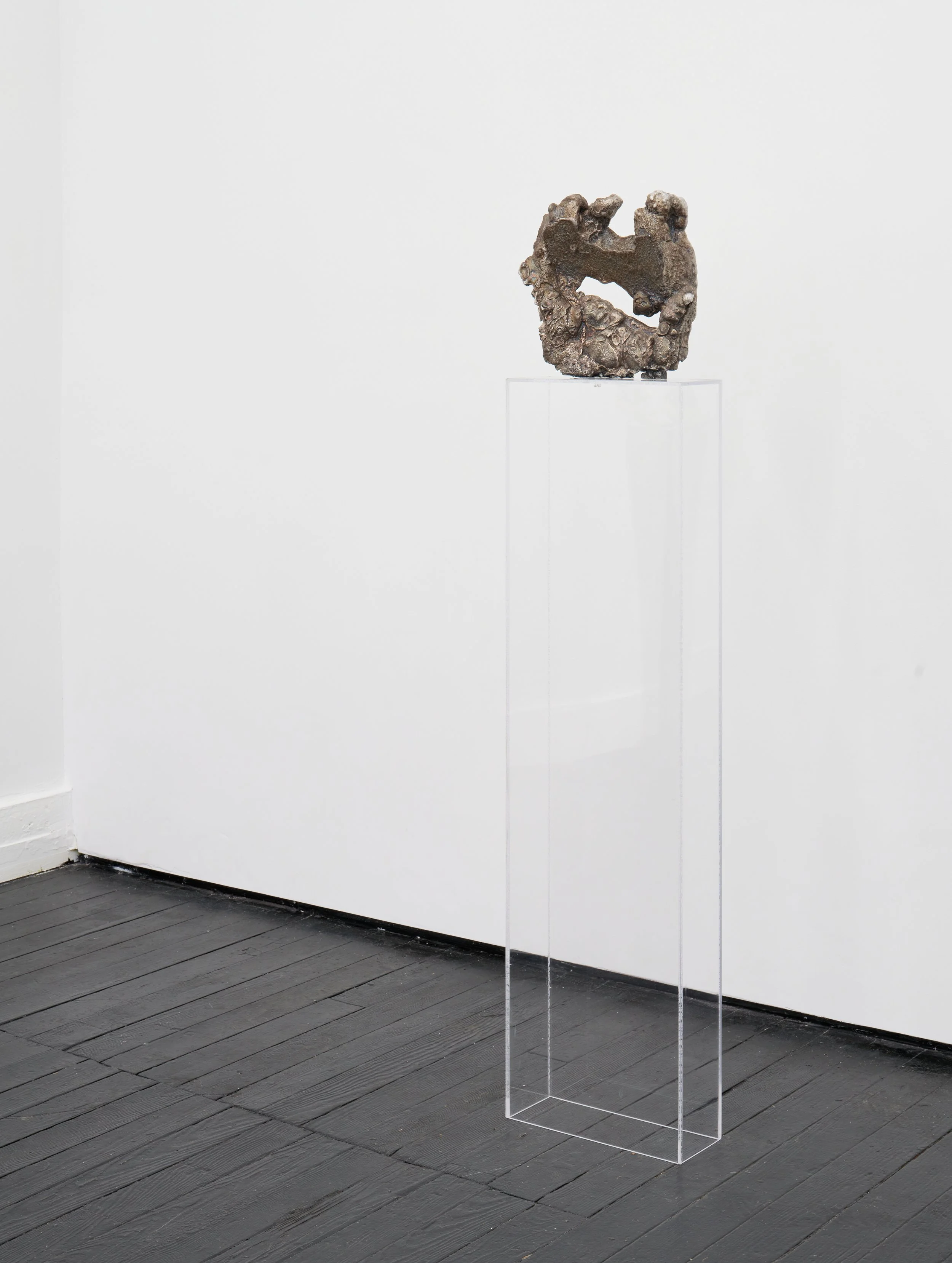
Jeff Williams “Cave” (2025) Cast aluminum12 × 15 × 2.5 inches (courtesy of the artist and Kate Werble Gallery, photo Brad Farwell)
The smith participates in the hidden processes of the planet. As the smith, Williams retrieves embryonic matter and completes its transformation through heat, hammering, and fusion. The industrial remnants of slag, crushed metals, and fused alloys, are subjected to acts of compression, welding, and reconfiguration that resemble metallurgical rituals and alchemical symbolism. Cave, a cast of land destroyed by invasive feral pigs is a cave within the cave. Resembling a pelvis, it is a fractal echo of self similarity across scale. Both womb and tomb, the cave, our center, is a site where matter and psyche dissolve and recombine. Filtered through the body, the ultimate cave, Williams’ work activates the role of the alchemist where stress and pressure refine. We are born Hanger and the rest is drag.
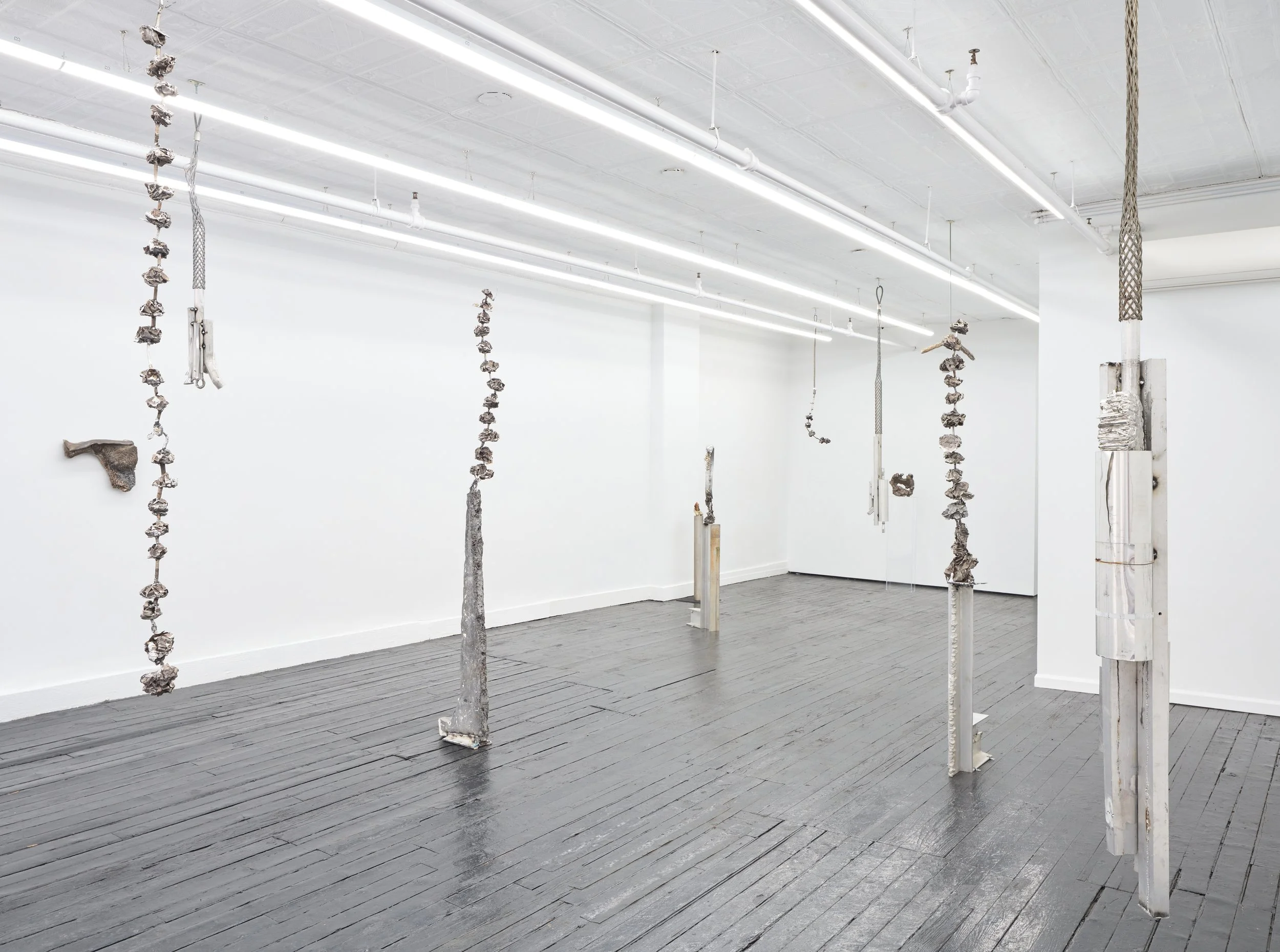
Installation view of Electro Slag at Kate Werble New York, NY (courtesy of the artist and Kate Werble Gallery, photo Brad Farwell)
Jeff Williams: Electro Slag at Kate Werble (474 Broadway New York, NY 10013) through April 18.