I Want to Believe: The Paintings of Melissa Brown
Wells Chandler March 5. 2026
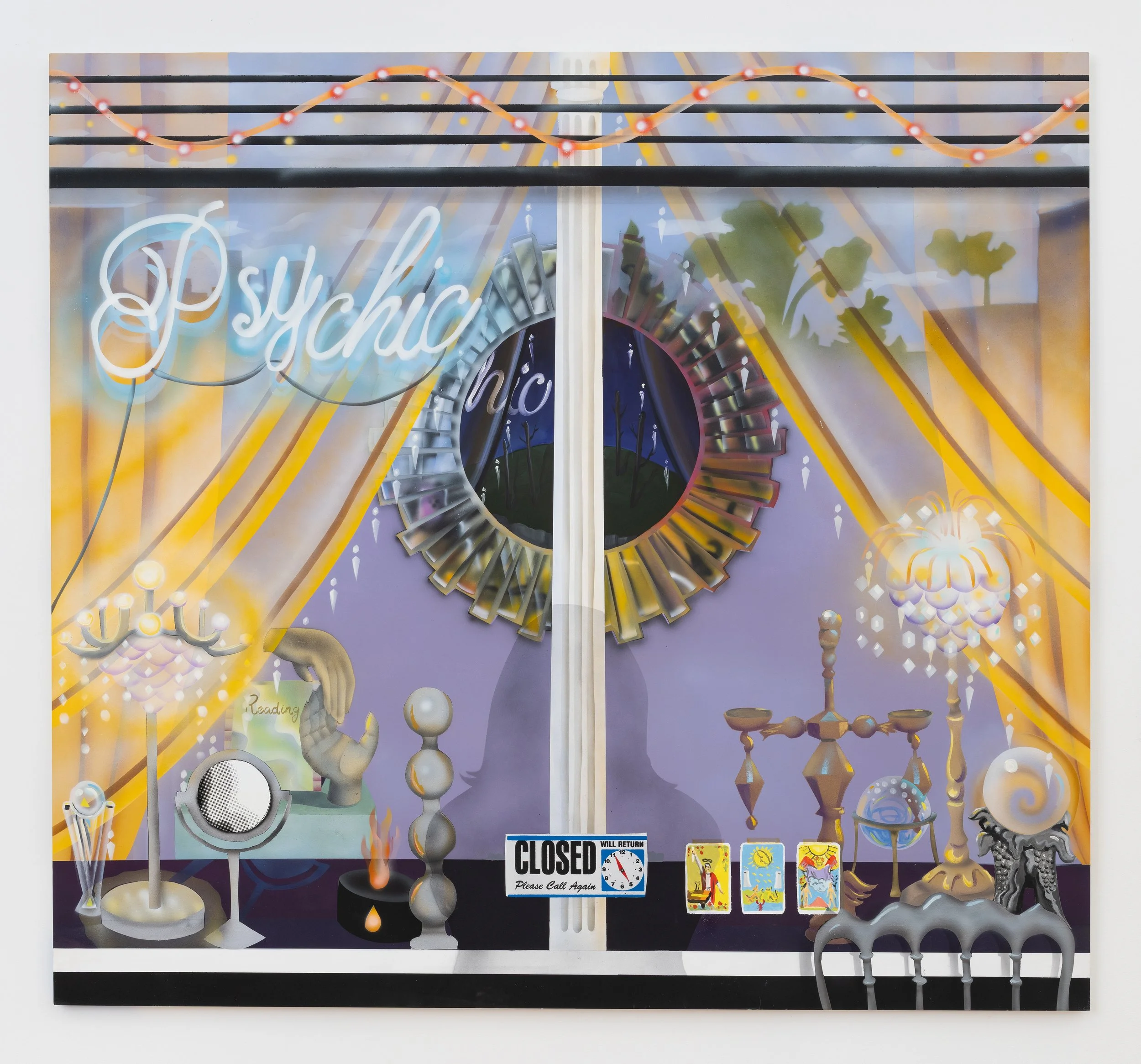
Melissa Brown “Psychic Window” (2026) Flashe, oil, acrylic, photo silkscreen on Dibond 59 × 64 inches
Melissa Brown’s paintings remind us that one only notices what one is willing to see. Her most recent body of work Window Shopping at Derek Eller is a collection of New York City’s weirdest and most memorable storefront displays. Simultaneously time capsules that nostalgically record the incremental erasure of brick and mortar trading posts as a result of gentrification and e-commerce, Brown’s paintings concurrently point towards the numinous.
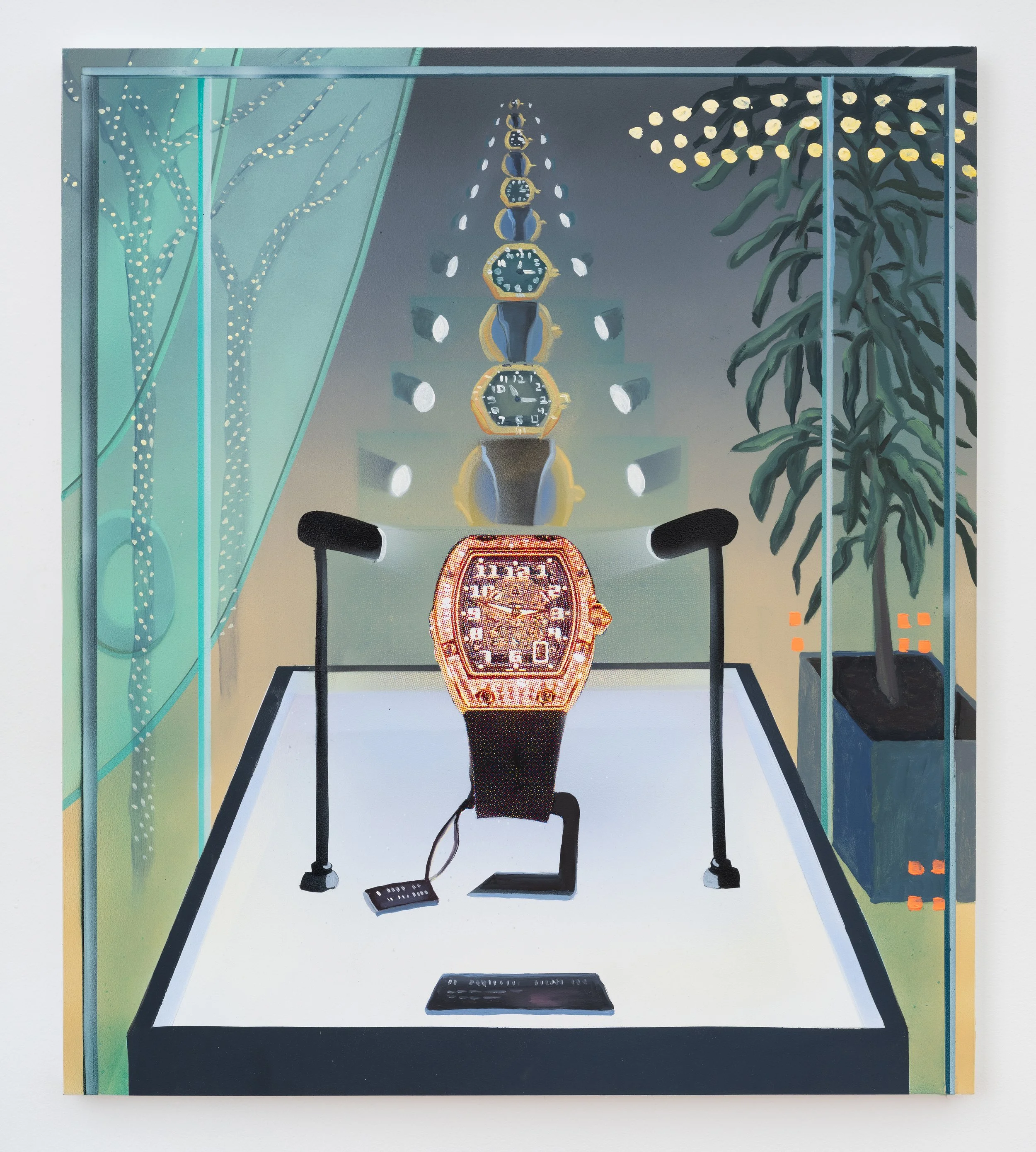
Melissa Brown “Time Display” (2026) Flashe, oil, acrylic, CMYK silkscreen on Dibond 24 × 21 inches
Brown begins each painting through a chance encounter, as if there really is such a thing. Time is synchronous as suggested in Time Display. Stacked bling-bling watches echo into infinity. Mirrored in glass, a mysterious vastness resides in the Baroque hyperreal of the current moment. Returning to the site of initial contact, Brown creates plein air observational studies that are later translated into ambitiously scaled airbrush and impasto paintings composited with print media in the studio. Evocative of glitchy VHS tapes and MTV’s The Real World, Brown’s paintings are the Garbage Pail Kids version of Lisa Frank. Stretching, folding, and compressing time and space, Brown empirically documents what Carl Jung would describe as externalized psychic phenomena, the paranormal material that forms belief.
Belief creates a psychic portal for other beings to enter our world as suggested by the presence of stoic, grey extraterrestrials probing a Bergdorf Goodman’s display on 57th and 5th in Fashion Figures. We believe ourselves into existence through contact, communion, communication, and consciousness. There is a porosity and generosity in the collective field that Brown constructs through culling together repeated open experiments of observation.
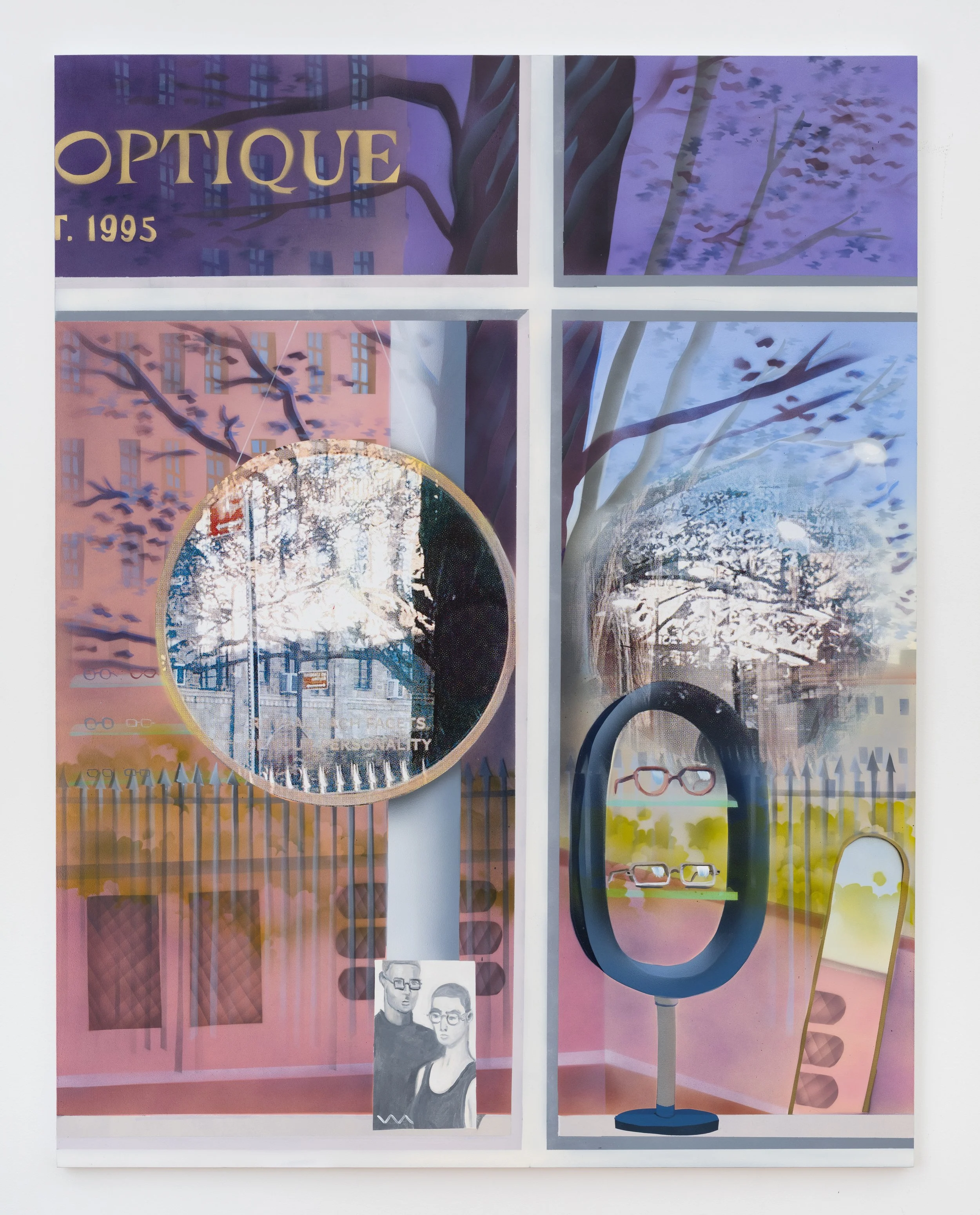
Melissa Brown “Optique” (2026) Flashe, oil, acrylic, CMYK silkscreen on Dibond 48 × 37 inches
Optique, a display for glasses, conjures John Carpenter’s 1988 sci-fi horror flick They Live. In the film, the protagonist pierces the veil by wearing a special pair of sun glasses that allow him to see subliminal messages behind advertising. Made of crystalline refracting light, Brown’s prismatic paintings suggest that appearances are a reflection of something real. It is well understood in quantum physics that perception impacts the behavior of particles being observed. The act of perceiving itself alters reality. The words of Phillip K. Dick, ‘We are not the artists but the drawing’ comes to mind when communing with Brown’s simulations.
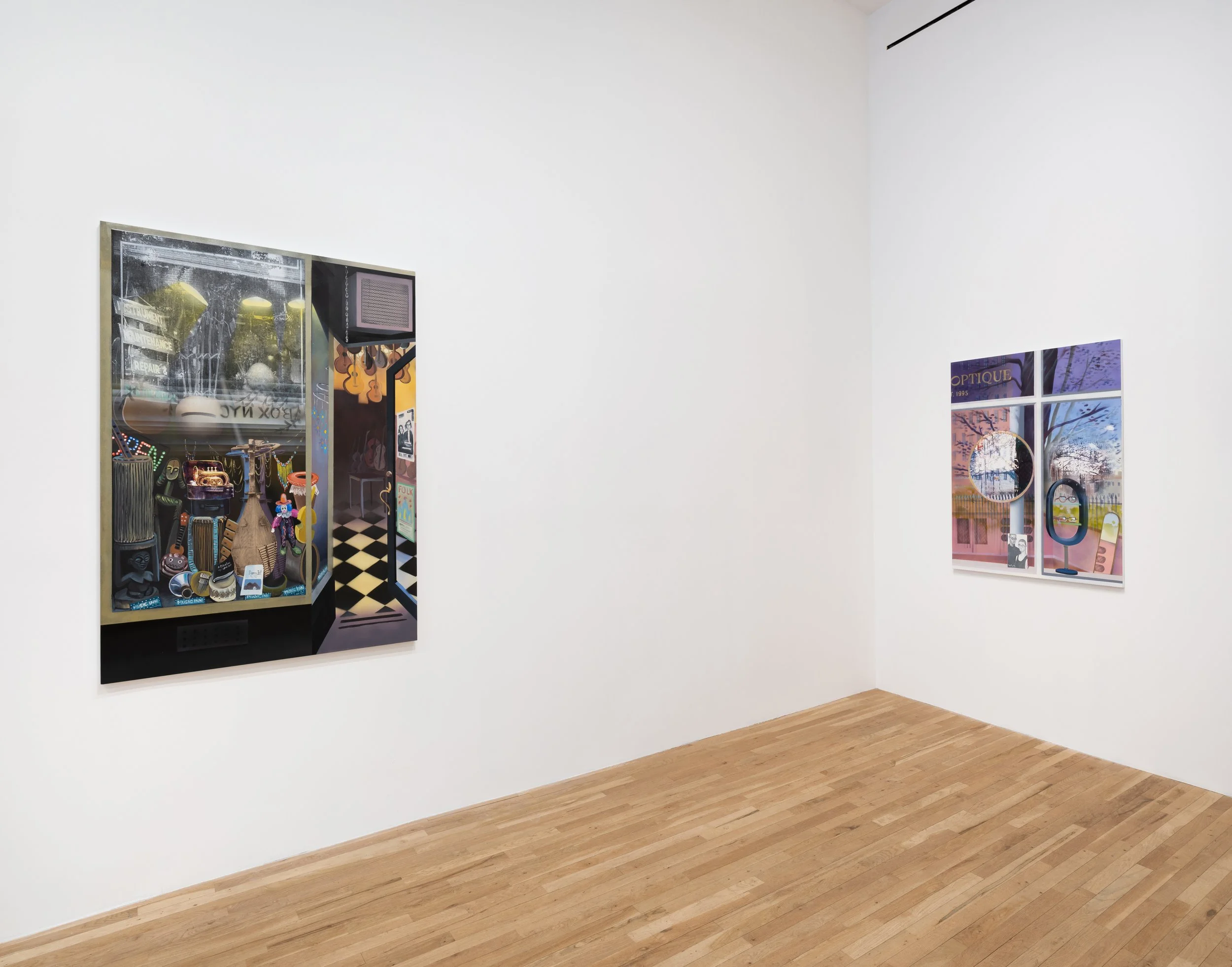
Installation view of Window Shopping at Derek Eller New York, NY
Walking in the surrealist footsteps of René Magritte, Jacques Lacan’s frameworks are applicable for Brown’s work. In The Treachery of Images, Magritte exposed the instability between image and thing. “Ceci n'est pas une pipe / This is not a pipe,“ severs representation from reality. Lacan formalized this split arguing that the subject is constituted through language and forever divided between the Imaginary (the image), the Symbolic (the signifier), and the Real (what resists symbolization). Desire arises in that gap. We pursue objects not for themselves, but for the lack they represent.
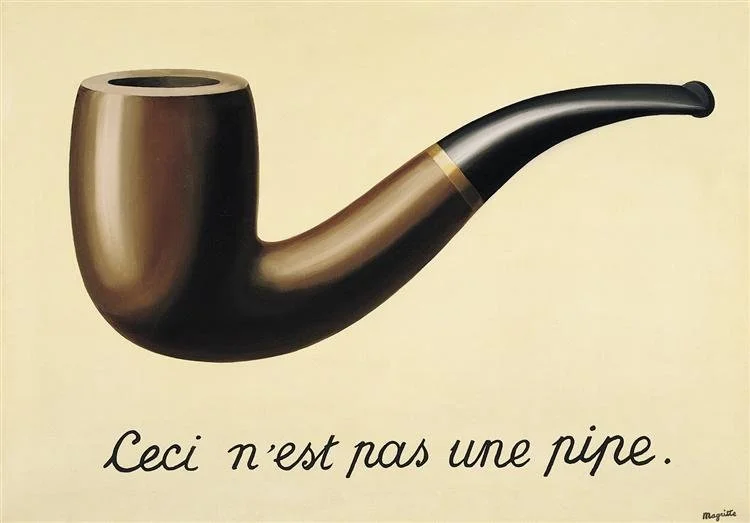
René Magritte “The Treachery of Images” (1929) oil on canvas 23.75 in × 31.94 inches
Continuing this legacy, Brown stages desire architecturally. Glass both reveals and withholds, reflecting the viewer while separating them from the object. The “imagined” (display, fantasy, branding) and the “real” (economic fragility, disappearance, time) coexist in an uneasy overlay. Spirituality enters here not as transcendence but as a structure of longing, a sense that something essential lies beyond. In Brown’s work, as in Magritte filtered through Lacan, the subject is divided by what it sees and cannot fully obtain. Illusion presents the unattainable within reach. Image, object, and the dream of wholeness are bound by desire.
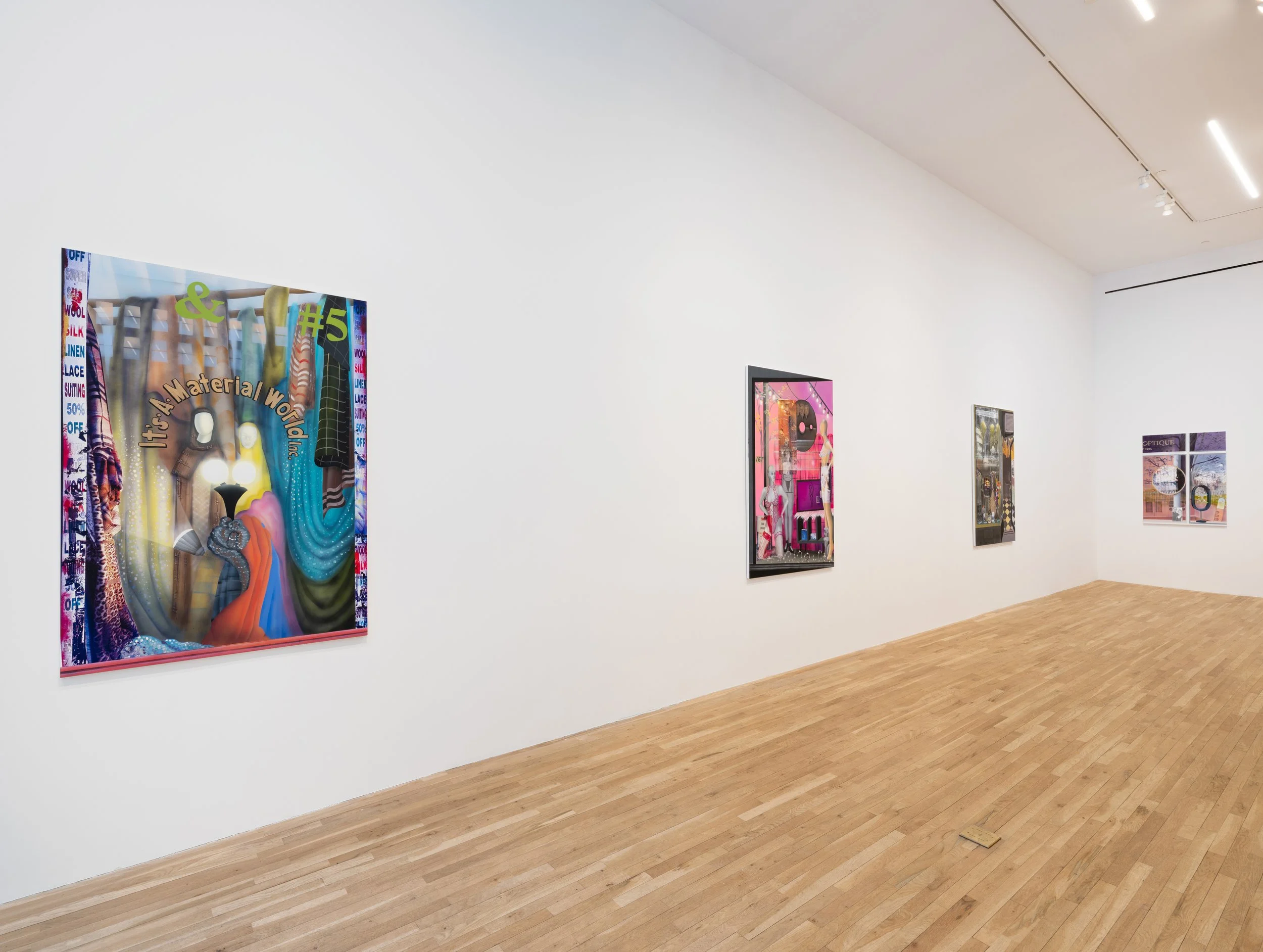
Installation view of Window Shopping at Derek Eller New York, NY
Brown’s luminous works propose painting to be a mythical object. Each enigmatic window is a ritual tool for ceremonial initiation to participate in and share collective fantasy. Psychic Window playfully and directly addresses this interest. Individually the paintings have the archetypal and mystical feeling of a well designed oracle deck, a set of cards used for divination purposes similar in function to the tarot.
Both tool and stage the paintings carry the charge of San Phra Phum, an altar that provides shelter for spirits that might otherwise inhabit the land where homes or businesses have been constructed. It is believed that when land is disturbed, the spirits who reside there need a new place to dwell, less they cause mischief or bad luck. Decked out in vibrant offerings and twinkling lights, domestic Taoist altars also come to mind. Brown’s paintings are contemporary versions of Spirit Houses, altars that honor impermanence and the ever changing nature of her home New York City.
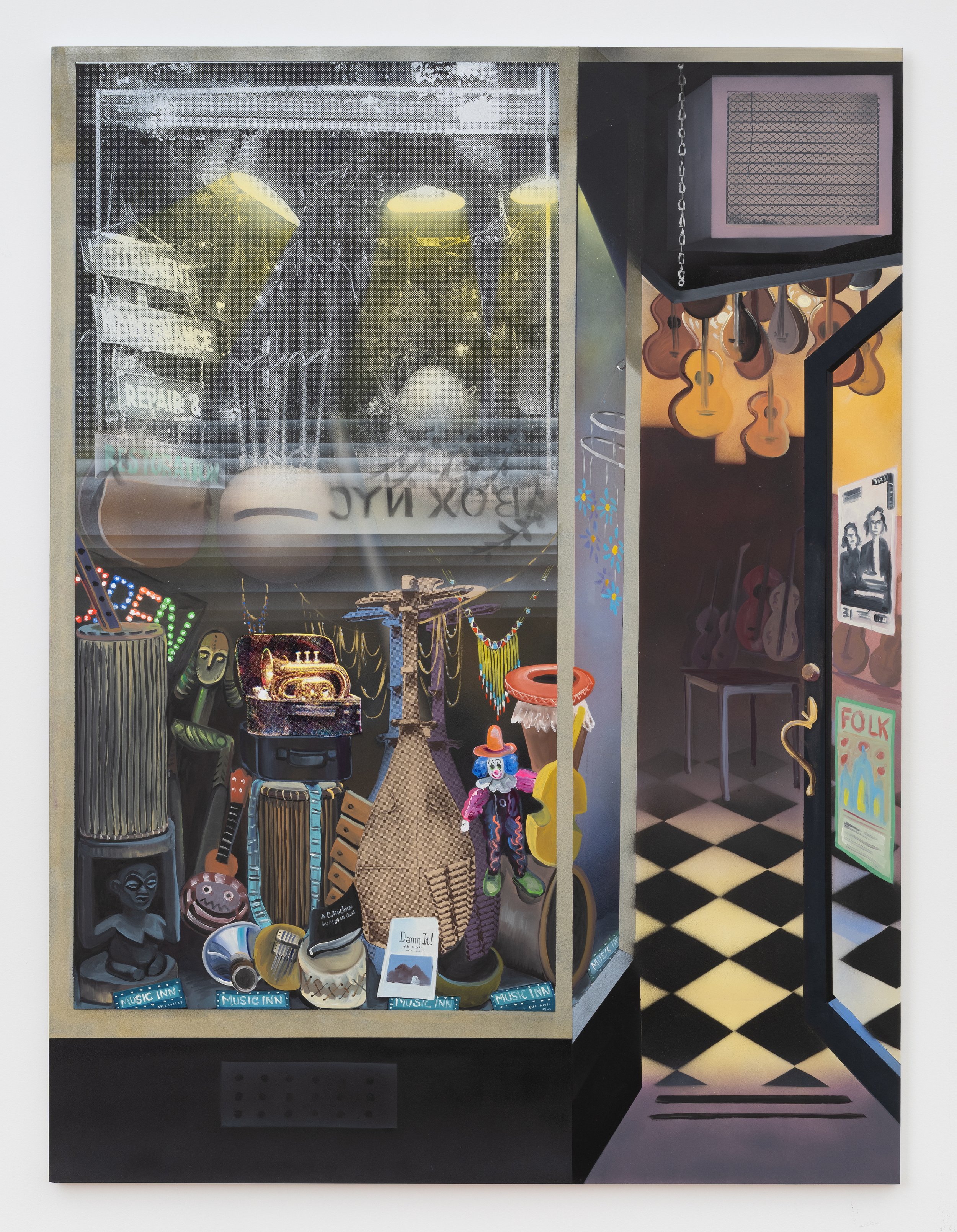
Melissa Brown “Music Inn” (2026) Flashe, oil, acrylic, photo silkscreen on Dibond 59 × 44 inches
Brown’s chromatic visions suggest that the physical world may be embedded in a much larger, older, and intelligent energetic consciousness. In the esoteric, non-dualistic Shakta-Shaiva tradition of Vamachara, also known as the left handed path, awakening is achieved by working with the five forbidden substances, to directly confront darkness and transcend duality. Pancha Makara is used to break attachments and perceive divinity in all things. Likewise Brown’s practice accesses spirituality within the kitschy, glimmering artifice of the quotidian. Everything is pregnant, indiscriminately imbued with potential to channel what lies beyond.
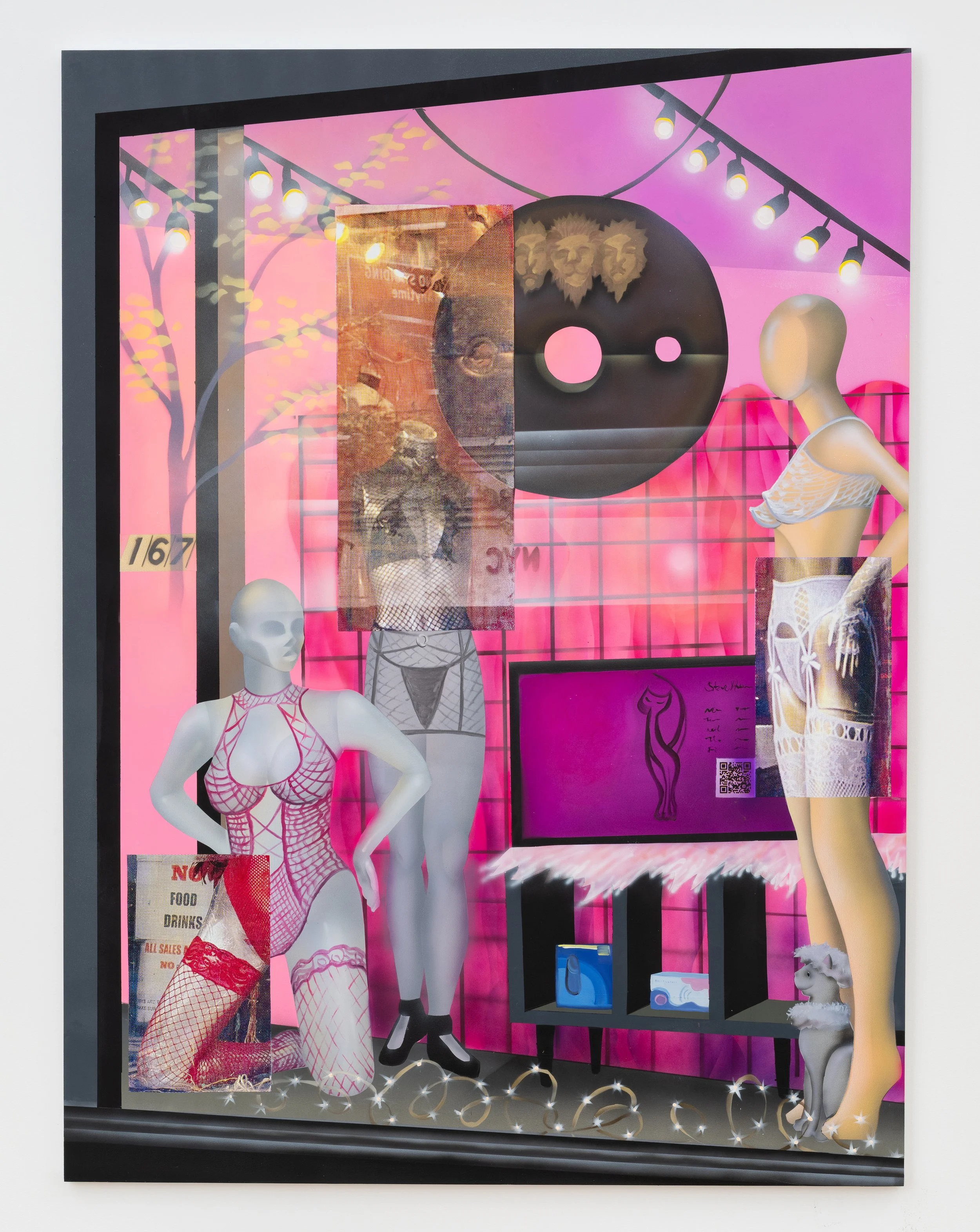
Melissa Brown “Pink Pussy Cat” (2026) Flashe, oil, acrylic, CMYK silkscreen, embedded video via QR on Dibond 59 × 44 inches
In Shivite Tantra, enlightenment is achieved through the union of Shiva with Shakti. The opening of the heart is followed by merging with the divine through balance and the integration of consciousness with libidinal energy. Brown’s paintings map this trajectory by staging longing and desire. Assisting in this endeavor, shamanic tools of ecstasy, both drumming and eroticism, serve as entrainment vehicles in The Music Inn and Pink Pussy Cat.
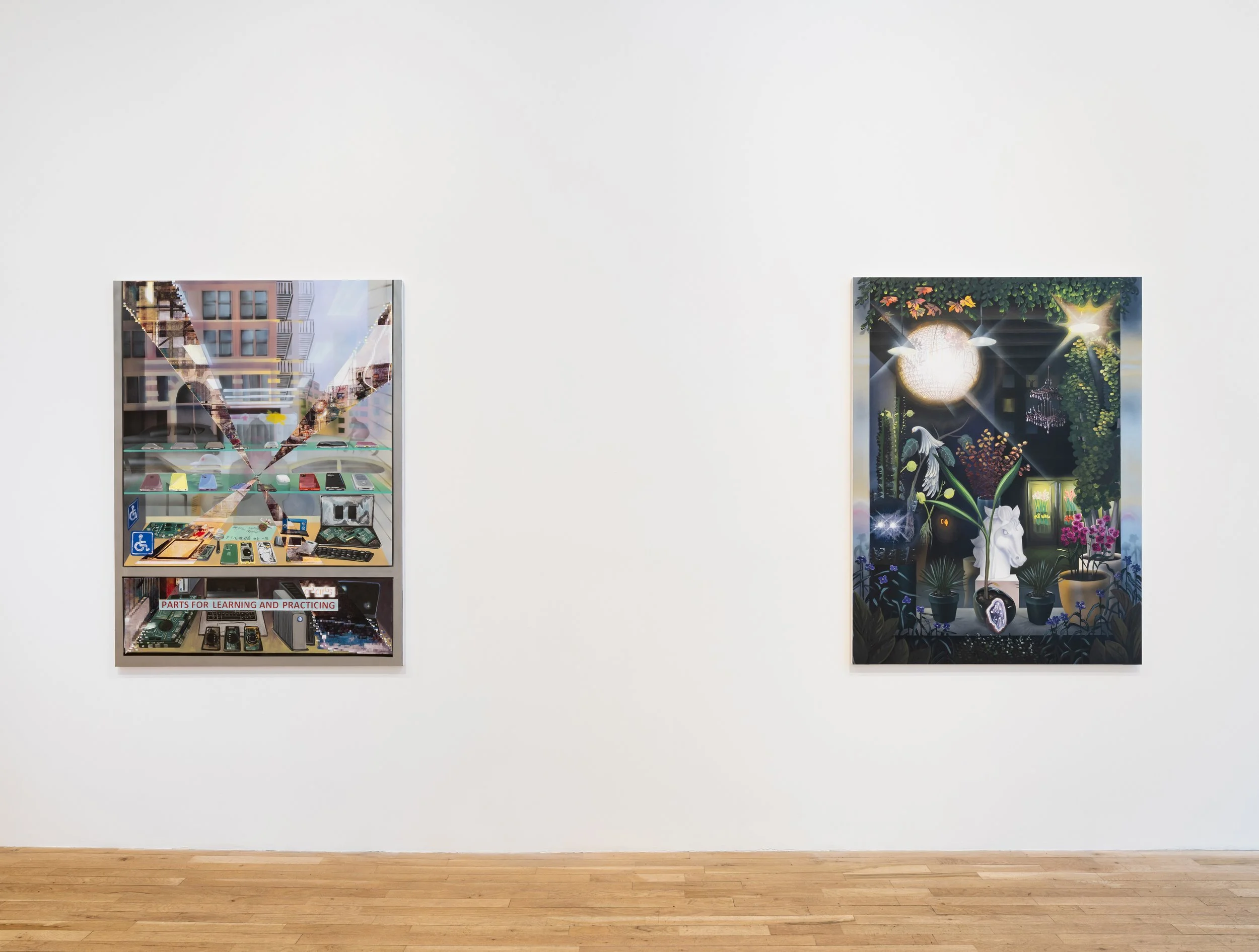
Installation view of Window Shopping at Derek Eller New York, NY
Reminiscent of a votive candle featuring the sacred heart of a compassionate saint, a radial axis emerges from the heart chakra of a shadow figure. Yin coalesces with yang. Perhaps a Hitchcockian portrait of the artist herself, Brown subtly structures Parts for Learning and Practice. Is planet Earth a school? What is the lesson?
Proposing questions rather than answers, Brown’s paintings are a bridge to a living mosaic of universes both astral and physical. Infinity is mirrored, reflecting reality as an endless strangeness. In Brown’s oeuvre, energy, vibration, electromagnetism, and light structure a perception that seems to extend beyond the appearance of its container. Advertising fabric, It’s A Material World, comically acknowledges one plane of existence while asking what is behind the curtain? Human beings sometimes encounter a knowing that is not experienced as the self and culture struggles to name it. As city dwellers of intersecting paths amongst the eccentricity of reality we come once again to the place of question. Who are we? What are we? Where are we? A spectral mare in Garden Nocturne is a reminder that we have just entered the Chinese Lunar New Year of the Fire Horse. Mapping the moons of the matrix, Brown’s paintings are an invitation to become present with presence.
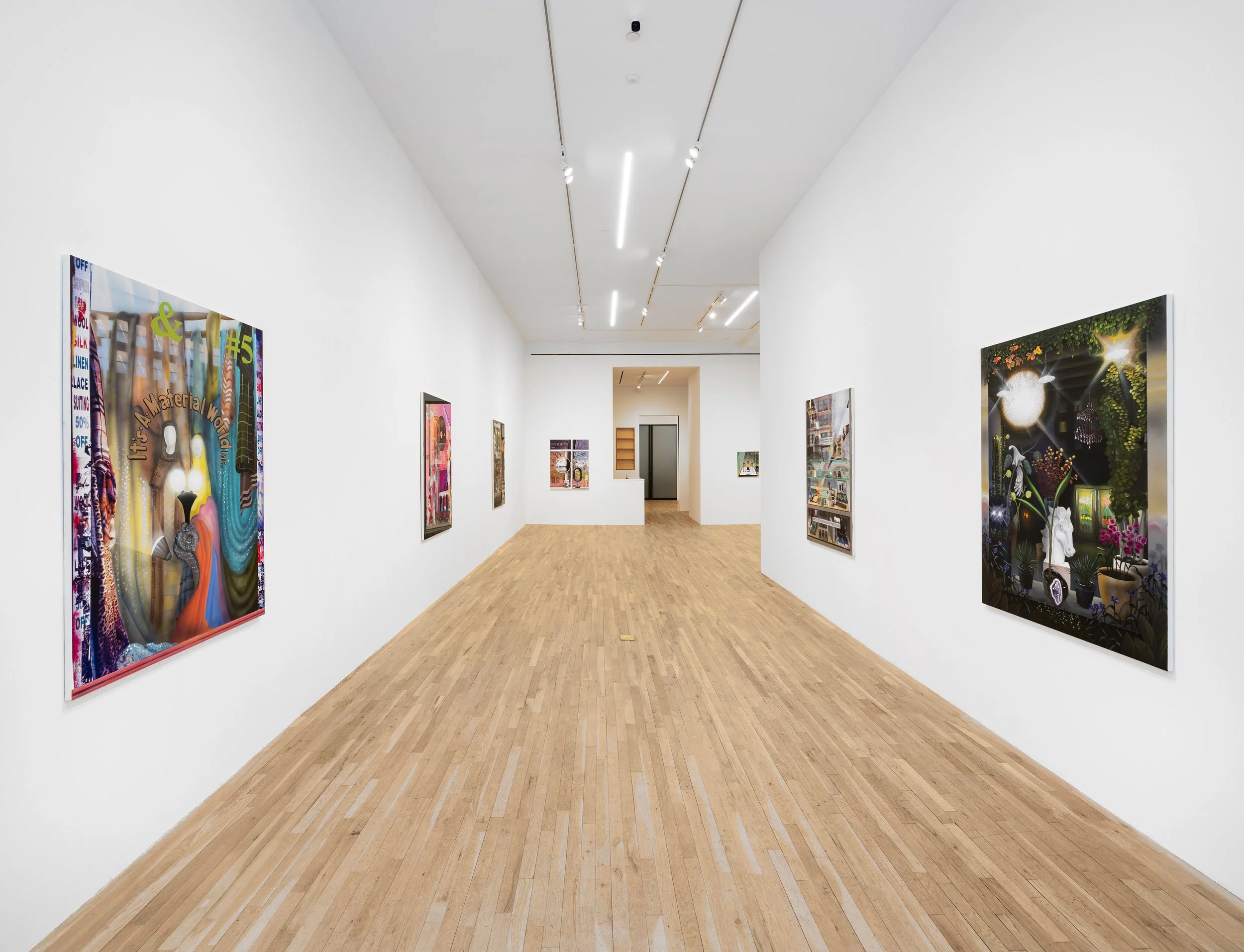
Installation view of Window Shopping at Derek Eller New York, NY
Melissa Brown: Window Shopping at Derek Eller (38 Walker Street New York, NY 10013) through March 21.