Decolonizing Reality: Joy Curtis’ Transpersonal Cosmologies
Wells Chandler April 30. 2026
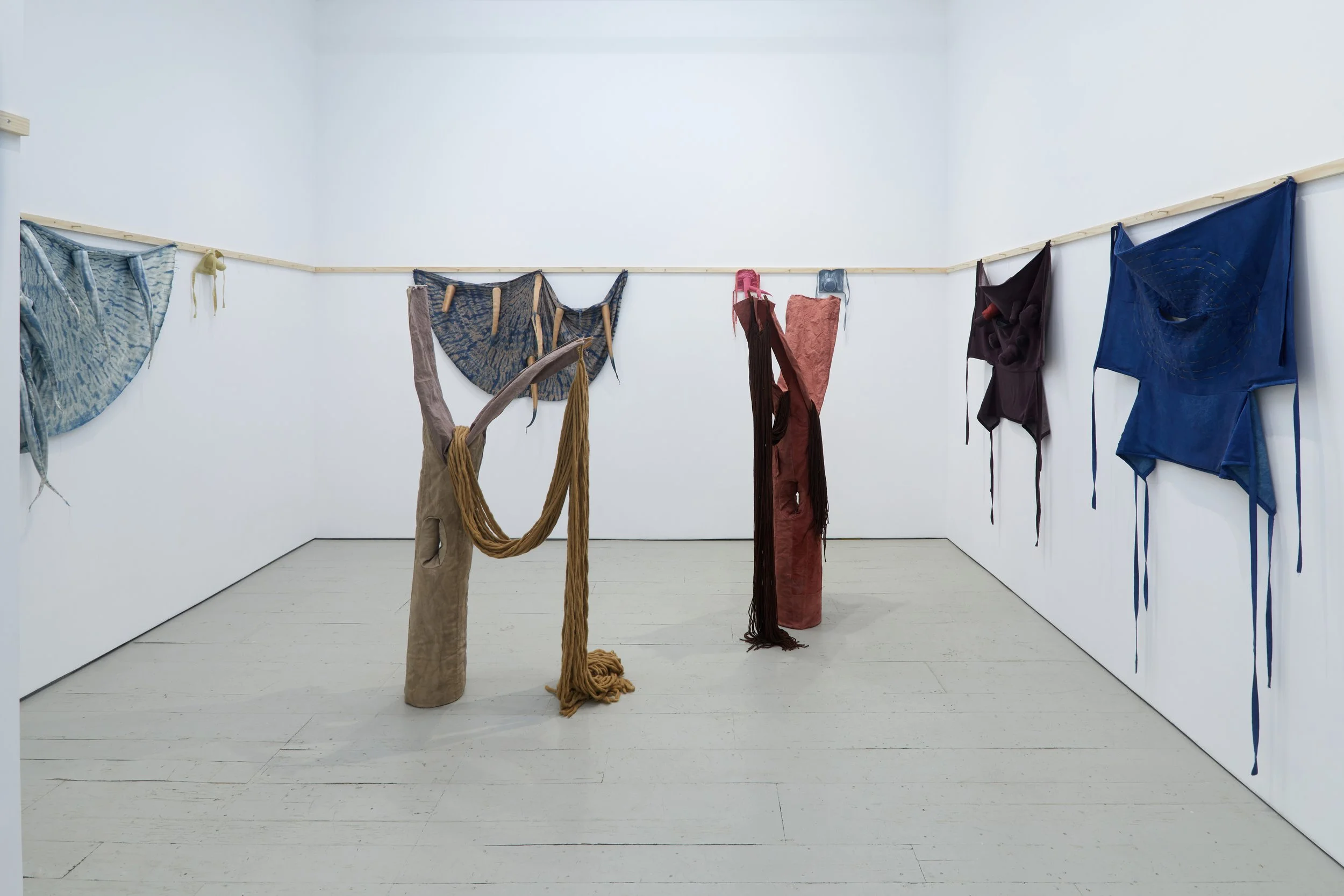
Installation view of Horns, Holes, Skins and Branches at Klaus von Nichtssagend Gallery New York, NY
We inhabit an era marked by confusion and estrangement from truth. In the Kali Yuga, discernment becomes difficult precisely because the real is fragmented across competing systems, ideologies, and embodiments. Intensified polarity is an initiatory condition. Hidden structures have a way of revealing themselves. Under sufficient ordeal, consciousness ripens. At Klaus von Nichtssagend Gallery, Joy Curtis sets the stage, ritualizing relational repair, healing, and protection in Horns, Holes, Skins and Branches.
In The Sacred and the Profane, Mircea Eliade argues that sacred space is a rupture in ordinary space, a breakthrough in which reality becomes oriented. Sacred space establishes a center, an axis mundi, where worlds meet. It is through such centers that human beings dwell meaningfully in the cosmos rather than chaos. Myth, for Eliade, is a living reality, an origin pattern actualized through ritual. Through what he calls eternal return, ritual restores participants to primordial truth. Curtis, whose role is revealed by the title, A Trickster Discreet as a Discontinuous Entity, is a fluent navigator of myth. She has excavated these structures devotionally for the past decade.
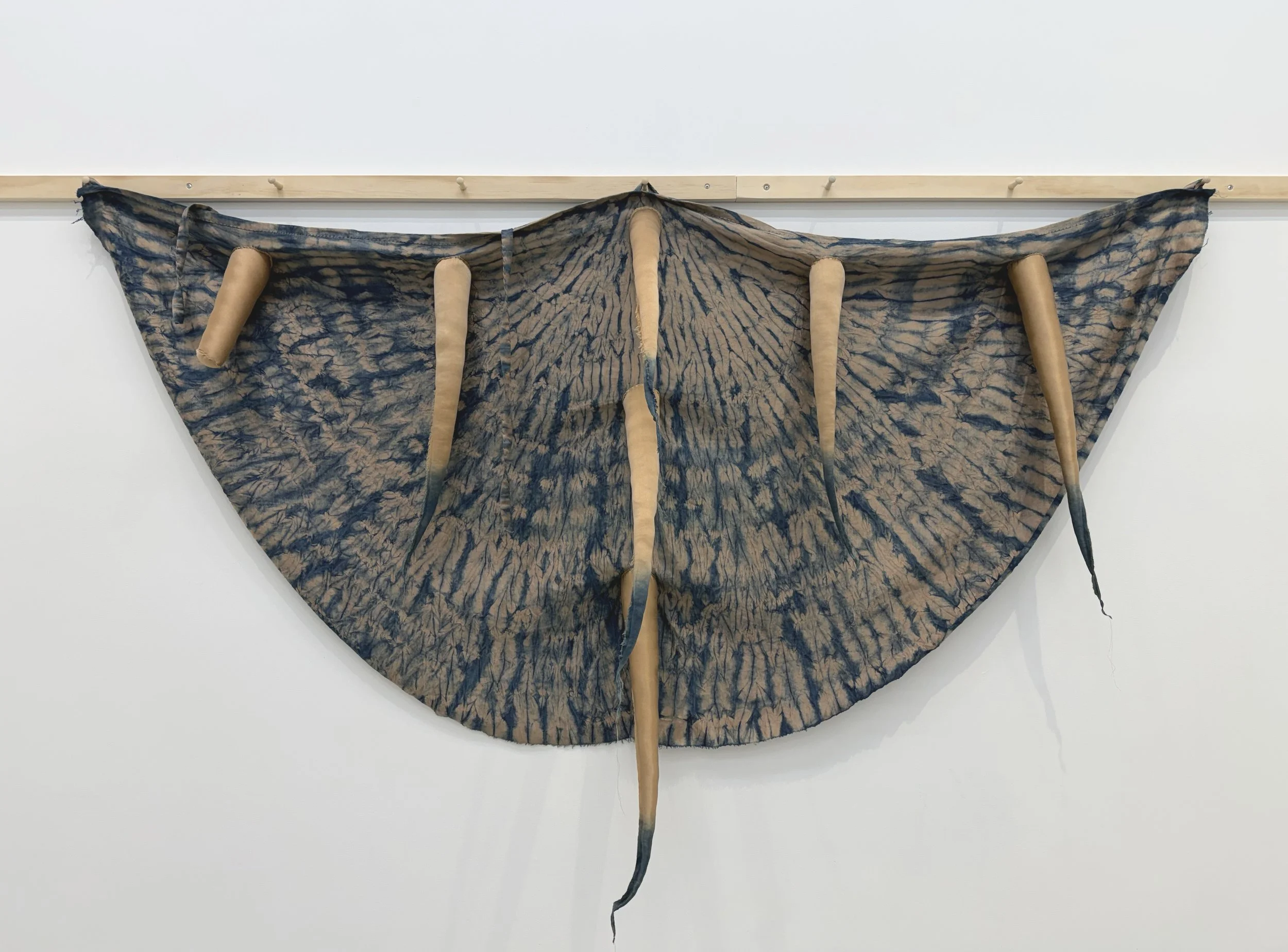
Joy Curtis “A Trickster Discreet as a Discontinuous Entity” (2024) Walnut and resist-dyed indigo on silk-hemp, kapok 76 x 49 x 8 inches
In Rites and Symbols of Initiation, Eliade outlines sacred transformation. Initiation is a symbolic death and rebirth, a crucible through which one undergoes ontological change. Beyond metaphorical self-improvement, this transformation of being requires a regression to origins, a descent into pre-formal states, darkness, enclosure, or chaos so that another form of life can emerge. Trial, secrecy, esoteric transmission, descent, and ascent are constitutive. Horns, Holes, Skins and Branches points to and reenacts this transmigration through materiality, process, and play.
Bound to entomological, mineral, and vegetal origins, Curtis’ use of madder, walnut, rudbeckia, indigo, and cochineal dyes concurrently carry civilizational memory. Indigo bears histories of fermentation, labor, protection, and deep time. Built through repeated dipping and oxidation, indigo materializes duration, storing process. Across cultures it has marked ritual cloth, work garments, and healing textiles. In Curtis’s work indigo carries these resonances of depth, night, slow transformation, and the celestial. Cochineal brings another register. Historically central to Indigenous American and colonial dye economies, cochineal is processed from insects, carrying associations with blood, sacrifice, vitality, and sacred authority. Its red is incarnational. In Curtis’ work cochineal animates the visceral dimension of textile as living matter, invoking interior life. Fused with the solar radiance of rudbeckia, these dyes form primary chromatic tuning forks grounding the exhibition.
This logic deepens through Shibori. Shibori’s operations of folding, binding, immersion, and release are an initiatory practice in itself. Pattern emerges through concealment. Form appears through what has been compressed. In Curtis’ work shibori mirrors consciousness taking pattern through pressure.
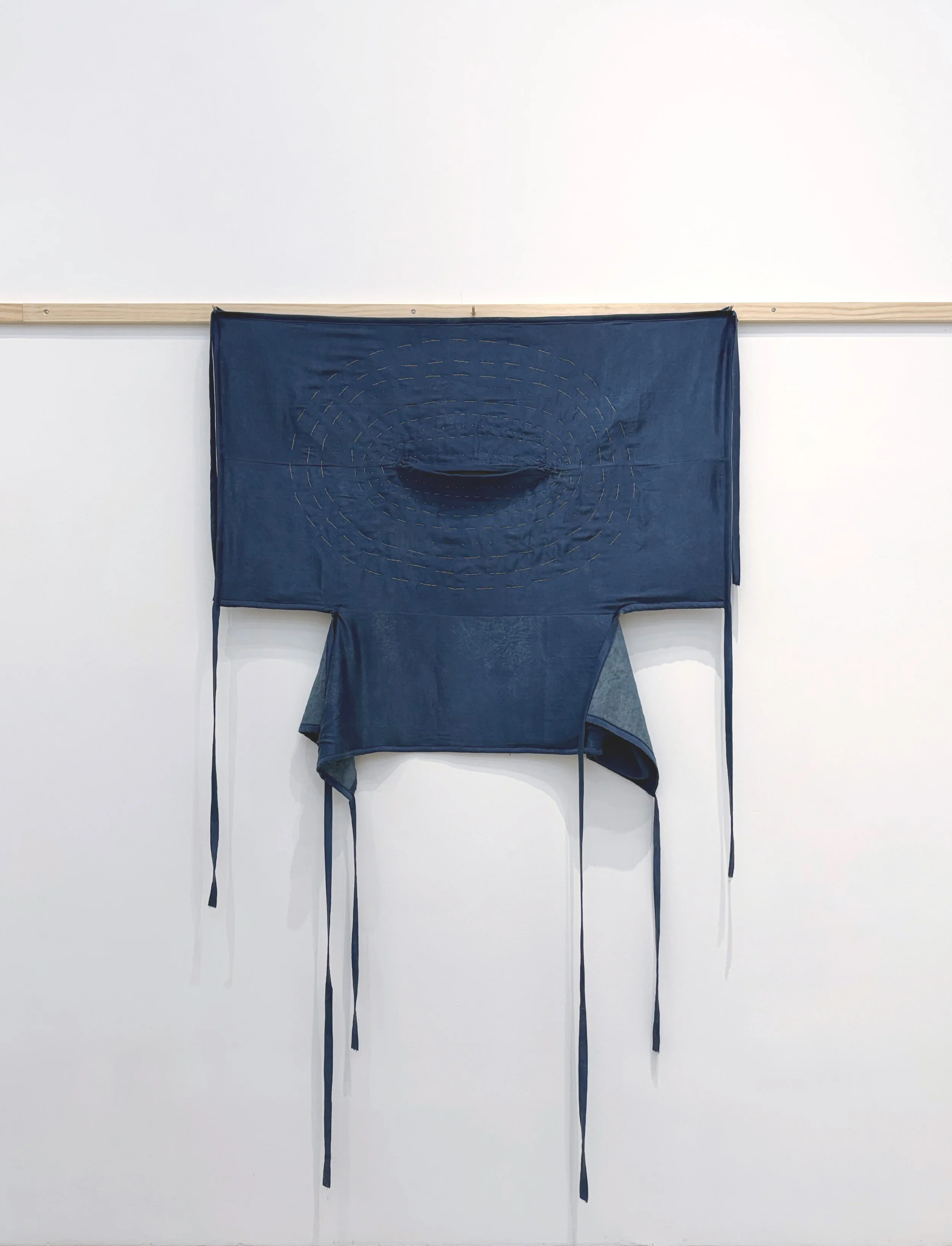
Joy Curtis “Sky-World Constellations are Relatively Eternal. Read the Pattern, Read the Future” (2025) Indigo on silk charmeuse and canvas, and embroidery thread 72 x 44 1/2 x 1 inches
Porosity, permeability, empathy, and expansion are operations through which Curtis’ instruments behave. Pattern recognition itself is initiatory as suggested by the title Sky-World Constellations are Relatively Eternal. Read the Pattern, Read the Future. Consciousness may be understood as a material in this work. Through an esoteric tantric lens, consciousness extends beyond private thought, as awareness prior to the division of subject and object. Curtis harnesses nonduality through performative activation so that consciousness may recognize itself as relational and interdependent. This is where Horns, Holes, Skins and Branches’ vitality takes root.
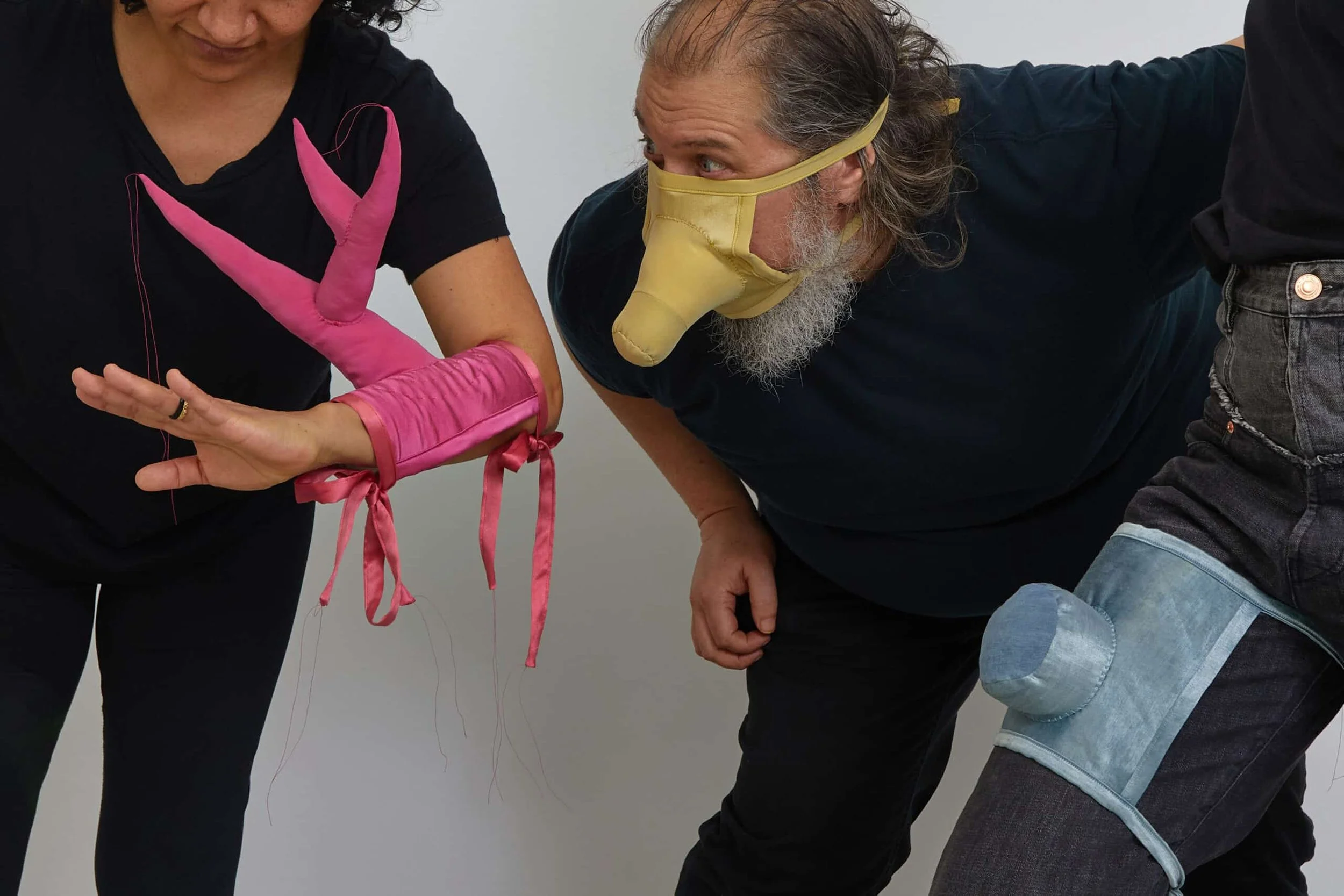
Activation with Mónica Palma, Michael Mahalchick, and Joy Curtis (2026) Horns, Holes, Skins and Branches at Klaus von Nichtssagend Gallery New York, NY
Curtis’ soft sculptures function as sacred objects and activated forms. Their relation to garment, tool, reliquary, and shield imply latent use. Even in stillness they hold performative potential. They suggest shedding, covering, inhabiting, and handling. Activation is embedded in their ontology. As prosthetics, they simulate a corporeal re-membering of who and what we are, extending beyond the limits of human origins. Curtis’ works propose an astral origin story, charting the progression of the soul through mineral, vegetable, and animal registers. The titles of works, He Could Change Himself Into Thunder, Rain, Plateaus, or the Number Arrangement and His Brother Was Wild Boi, Afterbirth Boi, Sunlight, and Natural Materials reinforce this epistemological shock. Curtis’ objects chart and symbolize metamorphosis and rebirth while participating as mystagogic tools.
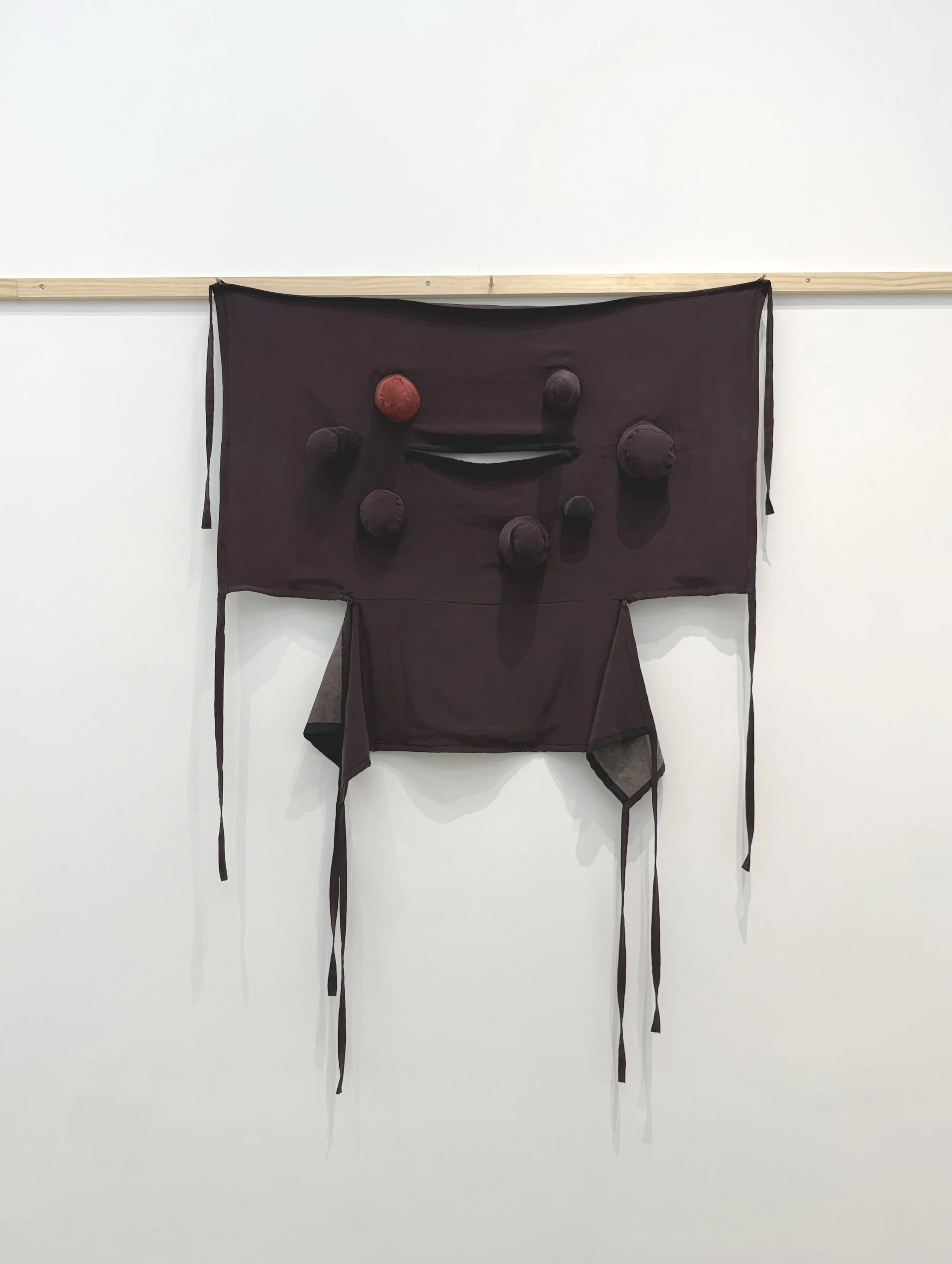
Joy Curtis “He Could Change Himself Into Thunder, Rain, Plateaus, or the Number Arrangement” (2025) Madder, logwood, and iron on silk charmeuse and canvas, kapok 61 x 44 x 5 inches
Donning long beards reminiscent of ancient sadhus, two cloth trees in the exhibition sharpen this structure. In Eliade’s writings on sacred trees, particularly in Patterns in Comparative Religion, the tree operates as a bridge, linking the underworld, earth, and the heavens. Conjuring complementary channels and balanced forces, Holzer 2 and Holzer 3 extend this symbolism. Named after the German surname for forest dweller, Curtis’ trees chart the path to awakening through generative balance and dynamic reciprocity. Old and wise, Curtis’ trees of life suggest the Ida and Pingala: pranic arteries, making the exhibition legible as a map of the subtle body. Comparatively the Kabbalah Tree of Life is relevant, accessed through balancing the pillars of Severity and Mercy through the equilibrium of the feminine yin and the masculine yang. Transforming the gallery into a sacred center and energetic diagram, Curtis’ devotional prosthetics aid in our endeavor to realize wholeness.
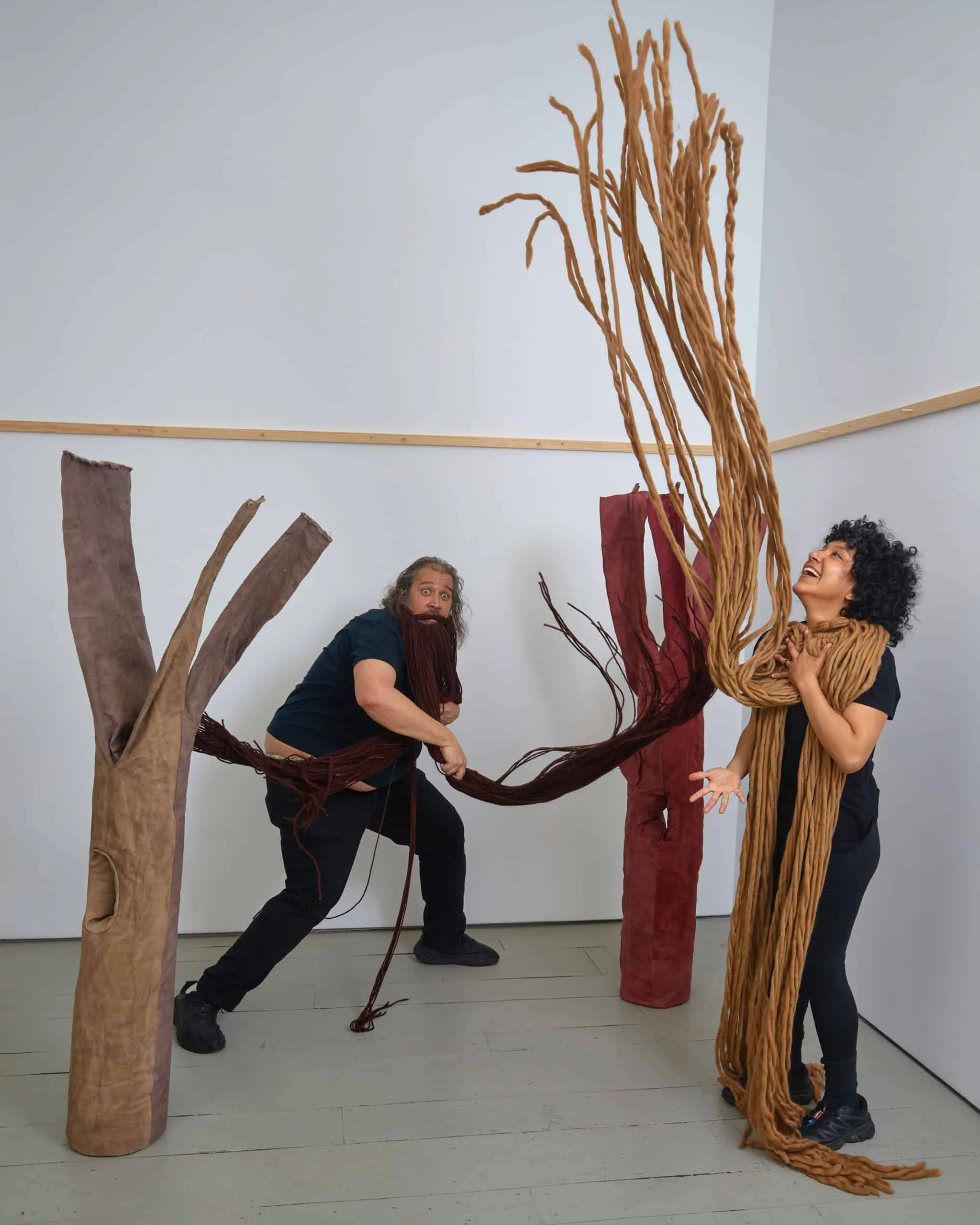
Activation with Mónica Palma and Michael Mahalchick (2026) Horns, Holes, Skins and Branches at Klaus von Nichtssagend Gallery New York, NY
Expanding upon arboreal travel, the anthropologist Michael Harner elaborates that the function of the tree is a cosmological portal, spirit presence, and ladder for shamanic ascent and descent. In The Way of the Shaman, Harner charts the shamanic journey through what he calls the Lower, Middle, and Upper Worlds. Trees, poles, and vines function as living pathways between these realms to access non-ordinary reality. Drawing directly on widespread Indigenous cosmologies, the cosmic tree joins worlds.
In Cave and Cosmos, Harner contextualizes nature beings, including trees, as spirit presences encountered by shamanic consciousness. Tree Spirit 1, 2, and 4 echo this sentiment. Harner frames trees as routes between worlds, intelligences, and teachers. This reflects a larger animist premise that the natural world is ensouled and communicative. Trees are beings with whom one enters in relation. Belonging to the “spirits of nature,” to commune with trees participates in restoring reciprocal consciousness with the living world. Enacting a twin gesture, Curtis’ arbol sculptures graft expansive cosmological routes through enacting compassionate embodiment. Through the natural world, Curtis midwives and swaddles us back to our birthright: to experience, to learn, to play, and to heal, restoring contact with one’s innate and inseparable spiritual power.
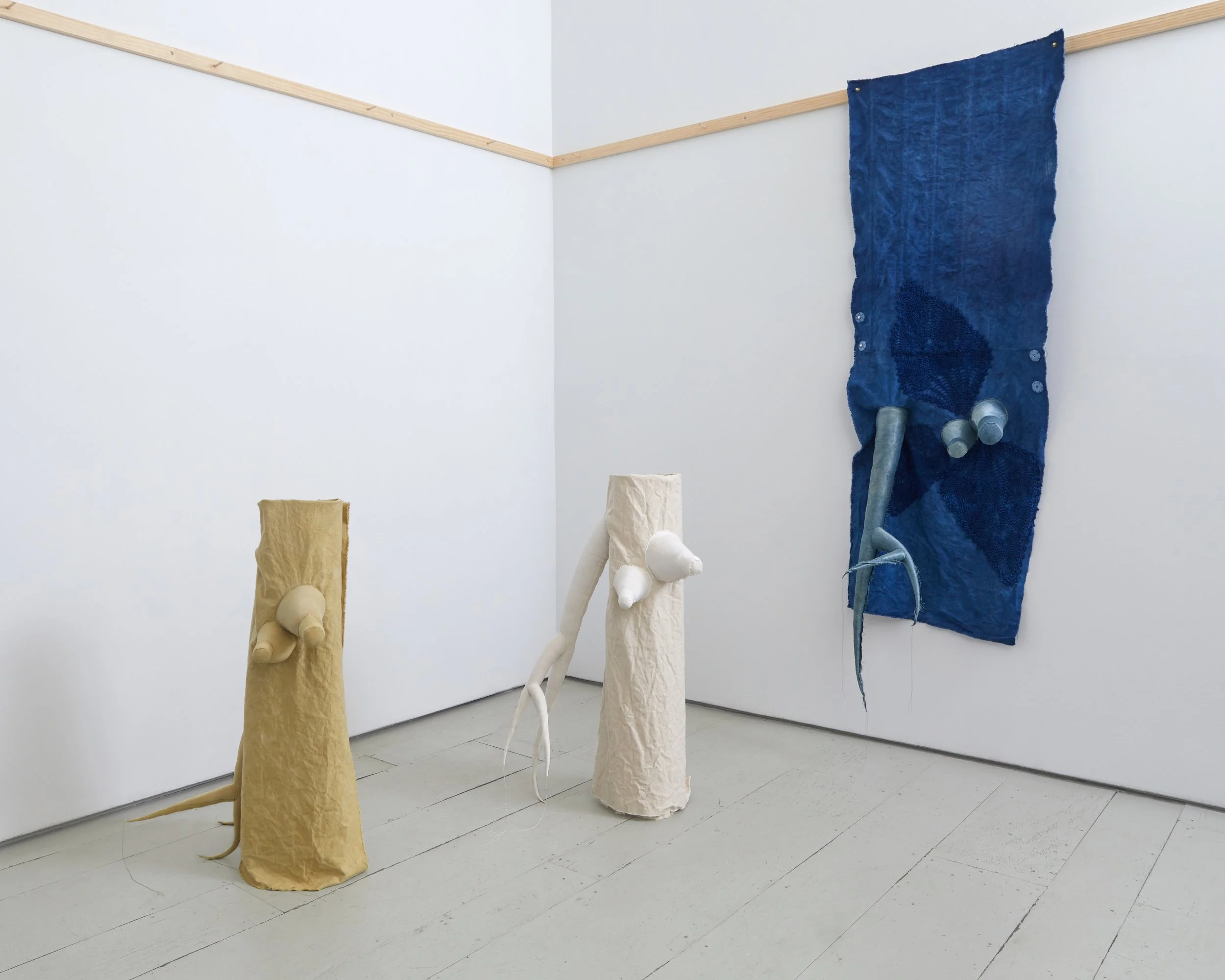
Installation view of Horns, Holes, Skins and Branches at Klaus von Nichtssagend Gallery New York, NY
Skins function as membranes between identities. Horns and spikes sewn onto epidermal capes can be understood as miniaturized trees, micro-arbors distributed across the body. Each nipple-like protrusion is a sprouting, rhizomatic node. The body itself becomes forested. Skin ceases to be an enclosure and becomes porous and generative as a seeded terrain. Soft spikes and cylindrical growths function as relay points in a hidden communicative network, much as mycelium links trees underground in reciprocal exchange. Each horn is a miniature axis mundi; collectively forming a distributed sacred center, a democratized world tree spread across flesh. Such a model subtly decolonizes hierarchical cosmology itself, replacing the singular sacred center with a plural, fungal, relational intelligence. Curtis’ polymorphous prosthetics propose a mycelial cosmology, blurring human, animal, fungal, celestial, and herbal categories. Because these works are worn and activated through performance, this arboriform network is not just represented but entered. The wearer becomes, shamanically speaking, the one who climbs the tree by simultaneously becoming it. Curtis performs cosmological propagation, grafting the cosmic tree to allow for sacred relations.
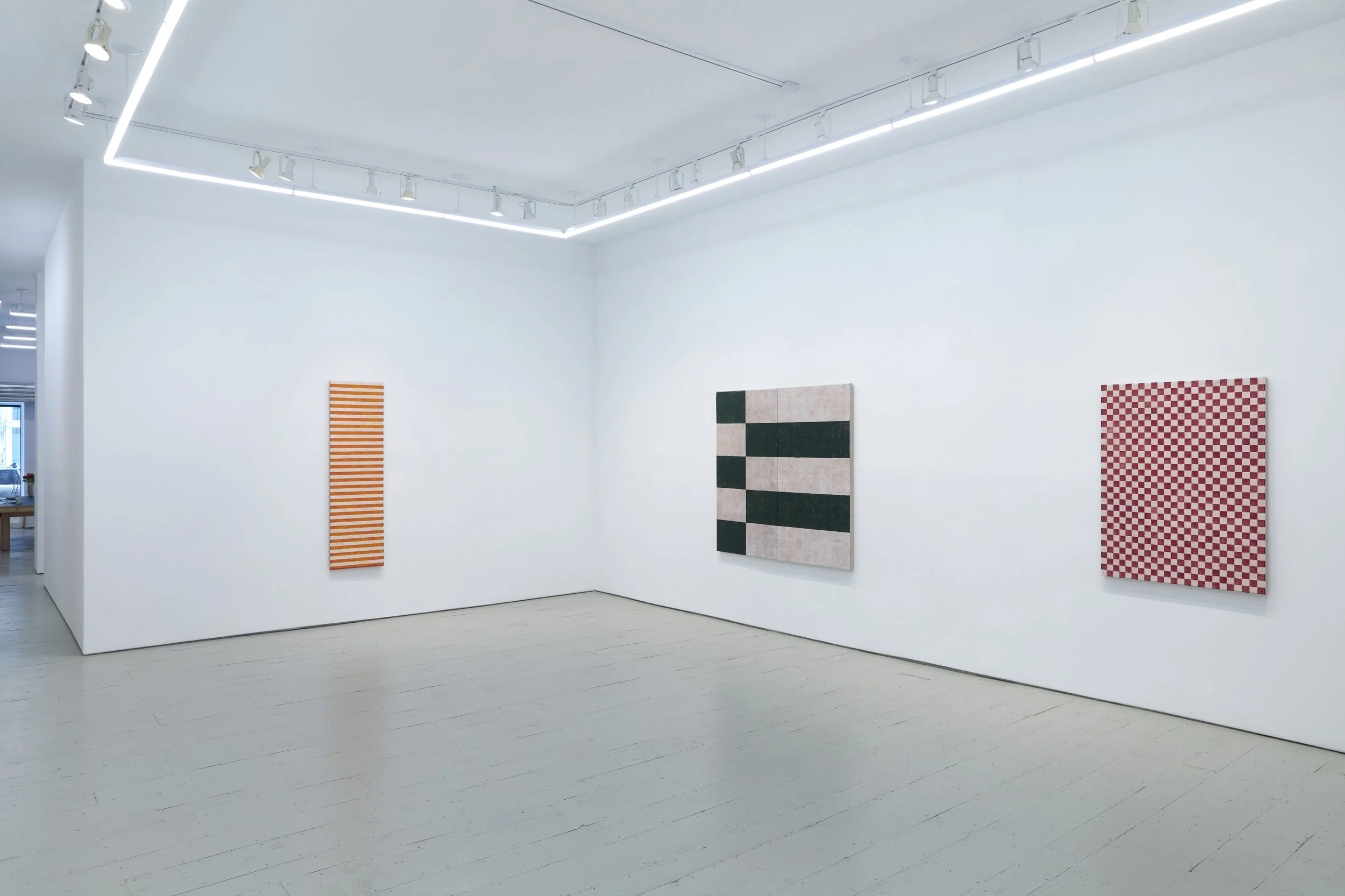
Installation view of Italian Paintings at Klaus von Nichtssagend Gallery New York, NY
Alongside David Scanavino’s Italian Paintings, which are structurally inspired by the marble matrices of churches in Florence, Curtis’ exhibition becomes a high priestess sanctum adjacent to hierophantic order. Skin is a crucial bridge between them. Scanavino paints on cowhide. The cow carries deep associations with Mithraic and goddess traditions. In both exhibitions animal material is transformed into a sacred vehicle. We are emotional beings. Healing requires sensitivity and being in touch with our feelings. Scanavino’s painted skins and Curtis’ transpersonal cosmologies share a similar impetus, to make contact and transmute collective pain through material devotion. Structurally the two exhibitions enact a related consecrated function to heal the feminine wound. Inner peace is the reward of this alchemical repair as stated in Matthew 5:5, “Blessed are the meek, for they shall inherit the earth” and in Luke 12:21, “The Kingdom of G-d is within you.” The concurrent exhibitions function as paired pillars or parallel modes of orientation, both winding paths that converge at a unified living center.
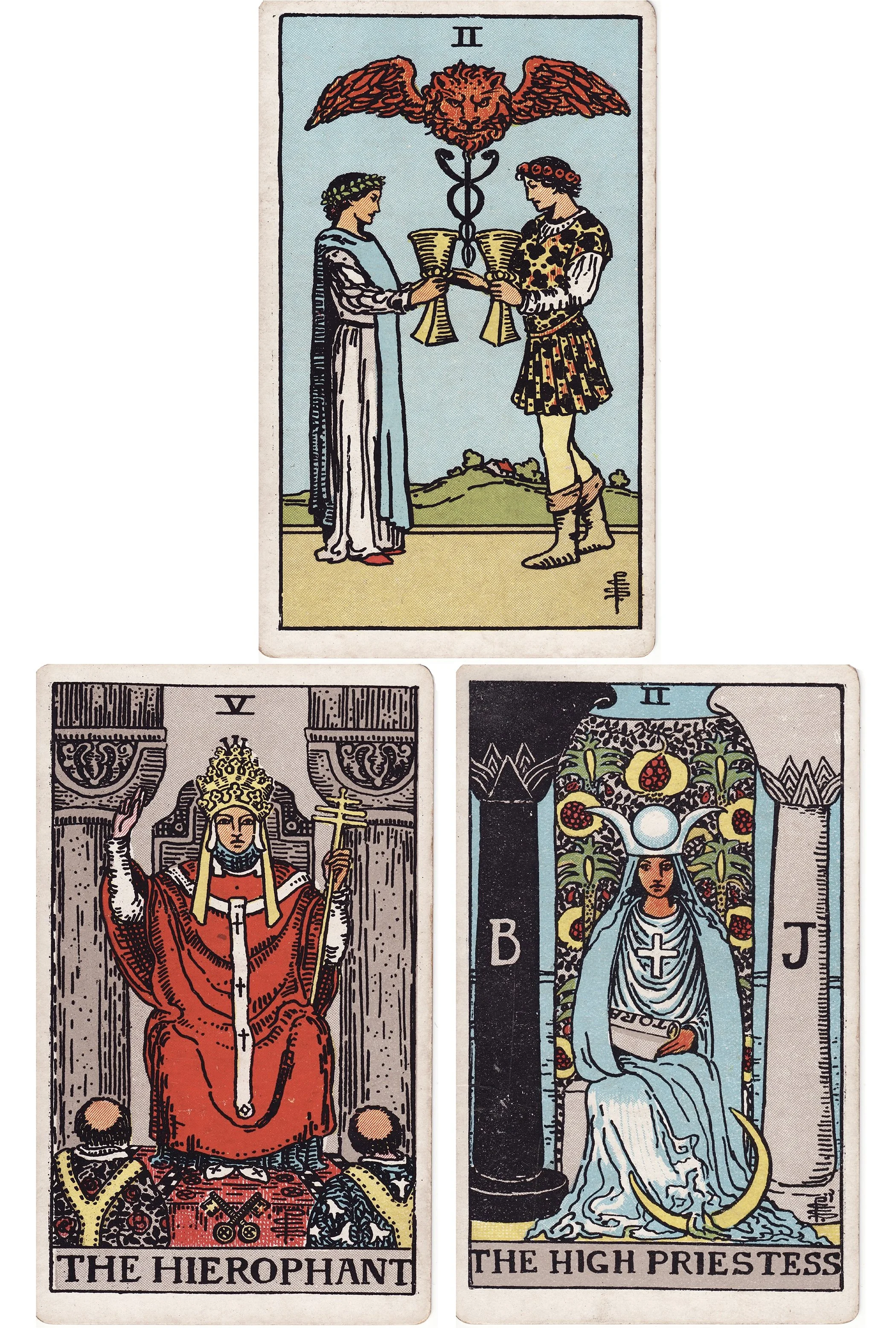
Pamela Colman Smith “Rider Waite Tarot Deck” (1909)
Within many tantric frameworks, liberation requires the transmutation of taboo. Shame and fear are often understood as energetic contractions that bind consciousness to duality through aversion and over identification with suffering. In both Hindu and Buddhist tantric thought, what is ordinarily rejected may become precisely the site of awakening when approached through disciplined awareness. The impure is not excluded from the sacred; it is re-read as concealed energy, allowing the poison to become the medicine. Horns, Holes, Skins and Branches resonates profoundly with this initiatory logic. Within this structure, the sacred feminine makes an appearance. The ultimate mother, the goddess Kali is summoned in the title of the work, She Caused Lightning By Sticking Out Her Tongue: Electrification, Consultation, Everything Earthly, or Underworldly.
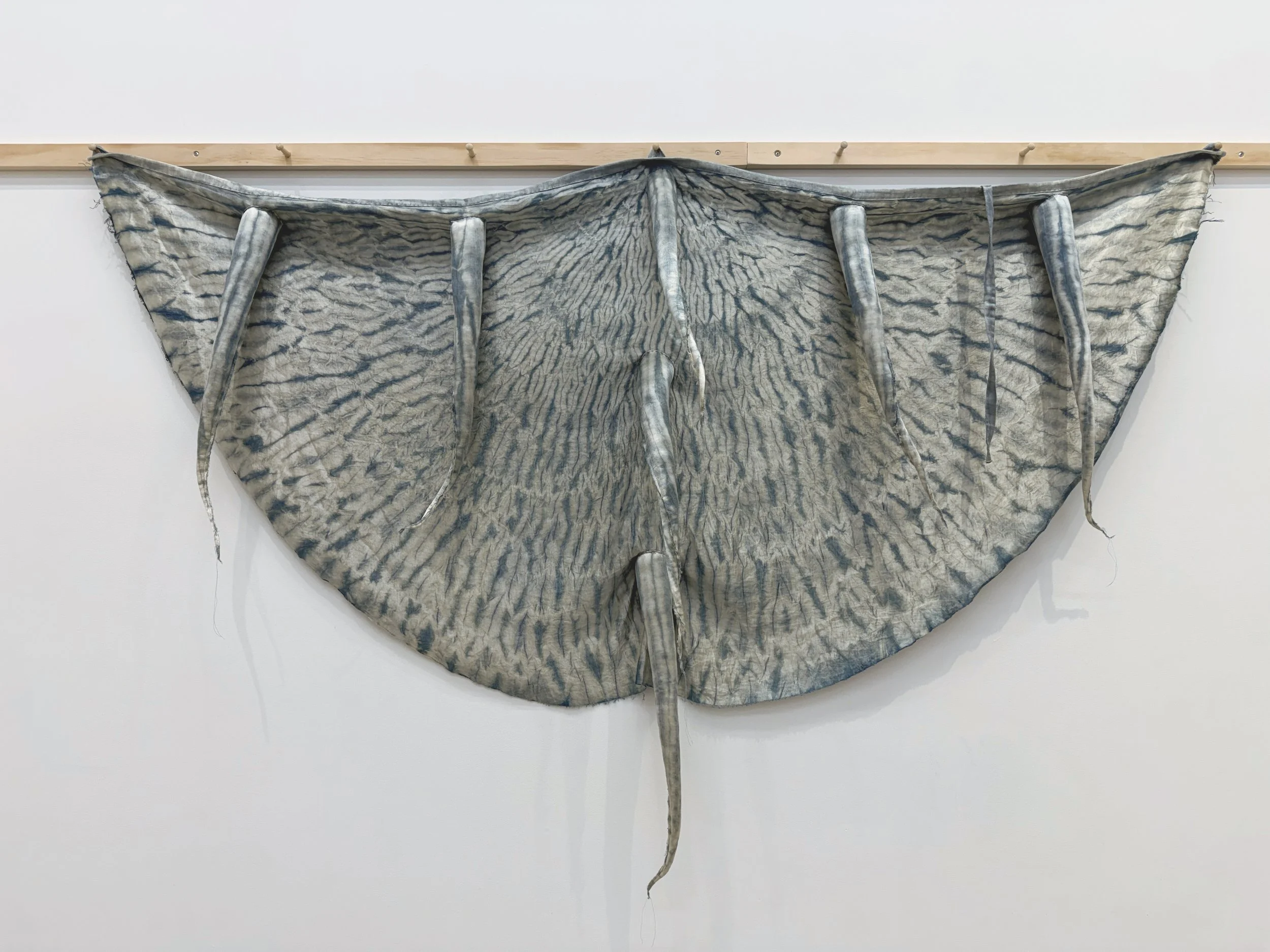
Joy Curtis “She Caused Lightning By Sticking Out Her Tongue: Electrification, Consultation, Everything Earthly, or Underworldly.” (2024) Resist dyed indigo on silk-hemp, and kapok 74 x 49 x 7 inches
The outstretched tongue of Kali holds symbolic meaning centered around eroticism, embarrassment, and the sudden shock of spiritual awareness. Kali, derived from Kala meaning time, is the eternal destroyer. Her tongue symbolizes the unquenchable, a blazing fire that endlessly consumes all life and time itself. According to legend, after a bloodlust-driven rampage, Kali steps on her ithyphallic husband Shiva. After his penis enters her vagina, in a state of pleasure she sticks out her tongue, which also happens to be a traditional Bengali gesture of embarrassment or shame. Kali’s protruded tongue symbolizes a moment of shock when the life force energy represented as Shakti becomes aware of consciousness represented as Shiva beneath it, resulting in the destruction of delusion.
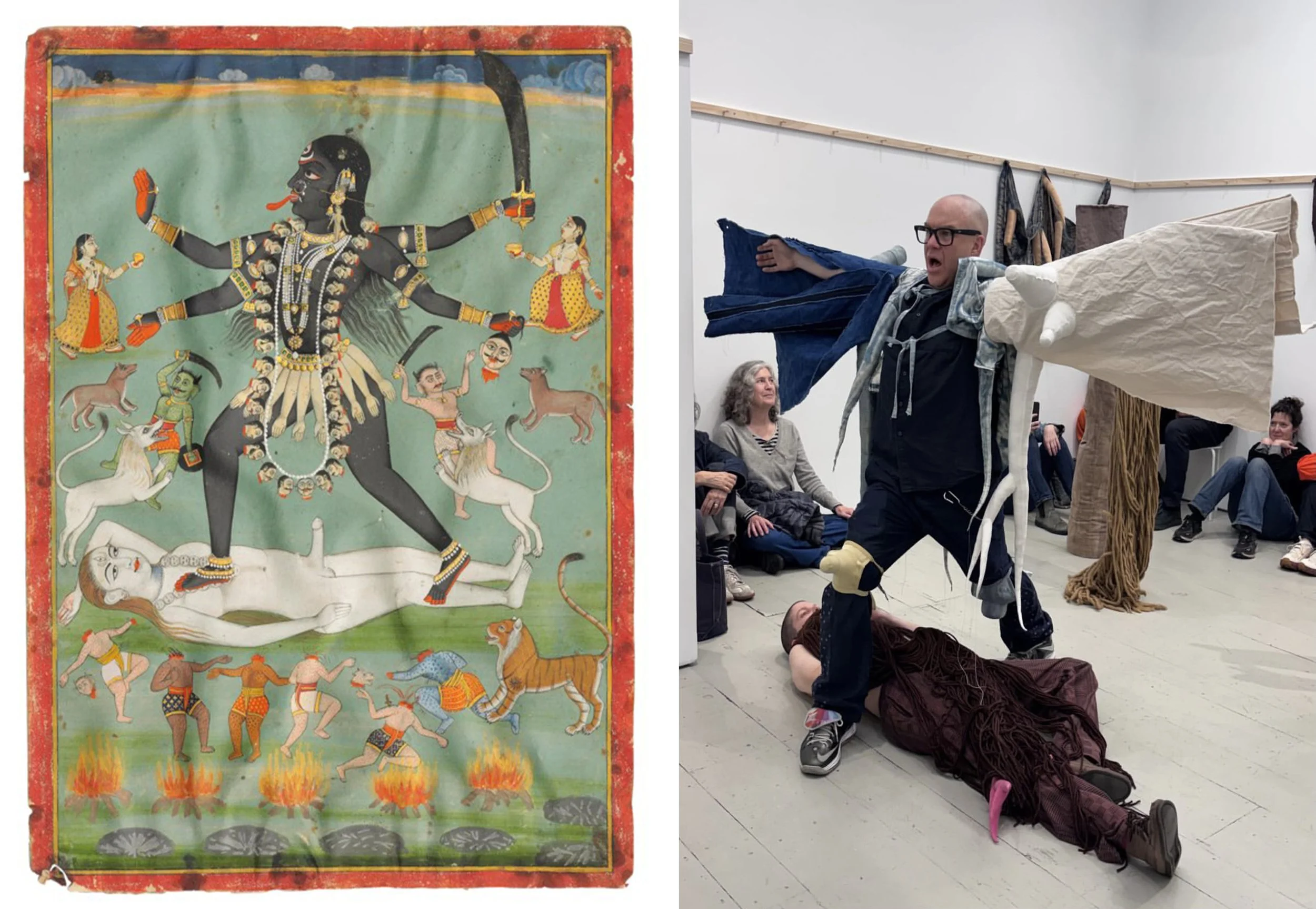
(left) The Goddess Kali Tramples Shiva (Early 19th Century) Jaipur Rajasthan, North India (right) Activation with Daniel Bainbridge and Wells Chandler (2026) Horns, Holes, Skins and Branches at Klaus von Nichtssagend Gallery New York, NY
Eroticism is sacred and vulnerability is strength as suggested in Curtis’ trilateral pelts. In Tantra, a downward facing triangle represents Shakti: the divine feminine, the creative force, the energy that becomes everything. Outstretched on pegs that suspend their form, Curtis’ triangular pelts are tantric portals suggestive of tongues flanked with combustive flames. Inside it, when activated, the many forms, the many bodies, the many lives all dissolve into the One. When Shakti awakens, the fragmented self merges and the illusion of separation fades. Horns, Holes, Skins and Branches is a map of consciousness charting the journey: from separation to unity, from body to energy, from mind to pure awareness.
Curtis’ practice can be understood as refusing the colonial partition that separates matter from spirit, body from symbol, disgust from sanctity, and sexuality from revelation. Decolonization must move beyond materialist critique and a pathological obsession with power towards ontological openness, and this is precisely where Curtis demonstrates authority, stepping into her role as a powerful healer.
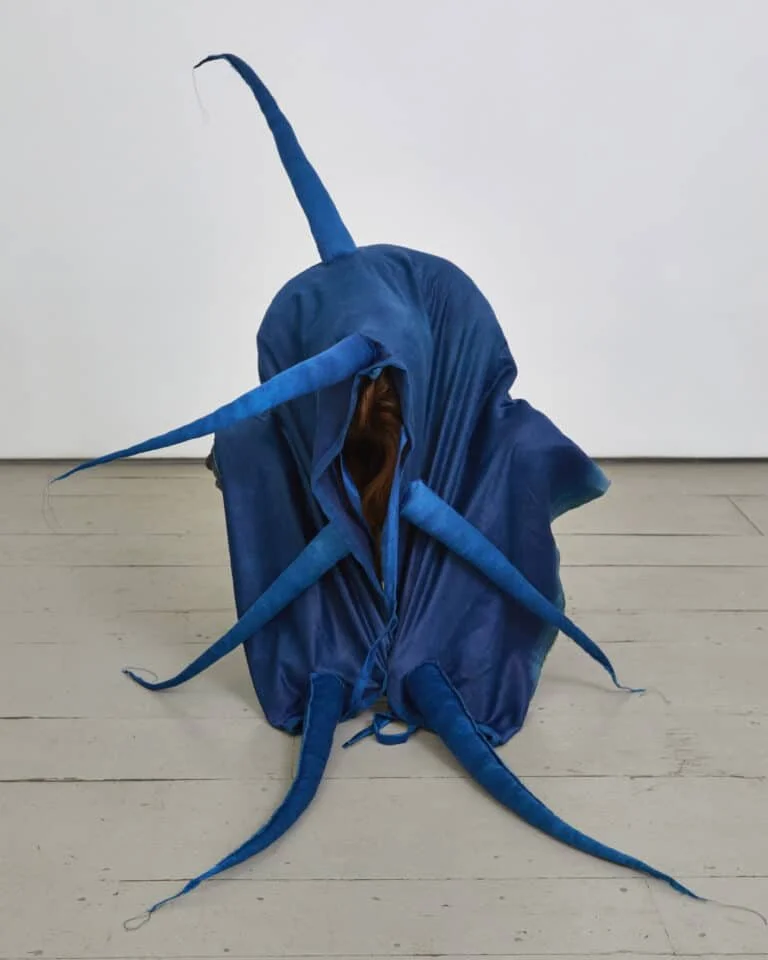
Activation with Mónica Palma (2026) Joy Curtis “Impersonator of the Foolish One: a Blue, Horn-Like Character” (2024) Indigo on silk-hemp, kapok 74 x 50 x 10 inches
Horns, Holes, Skins and Branches dwells in what American religious studies scholar Jeffrey J. Kripal calls the “impossible”: a reality where eros carries gnosis, where monstrosity veils sacred presence, and where the body is the medium to transcendence. Recurring dualities: interior and exterior, masculine and feminine, human and animal, wound and ornament, destabilize binary oppositions by moving toward conjunction. Curtis’ work decolonizes perception by refusing the modern secular demand that sacred reality be invisible. Instead, Horns, Holes, Skins and Branches renders sacred reality to be enchanted and participatory. The viewer does not have the option to enter as a detached observer. They are drawn into a field of symbolic contagion, much as Kripal imagines consciousness itself participating in a more-than-material cosmos.
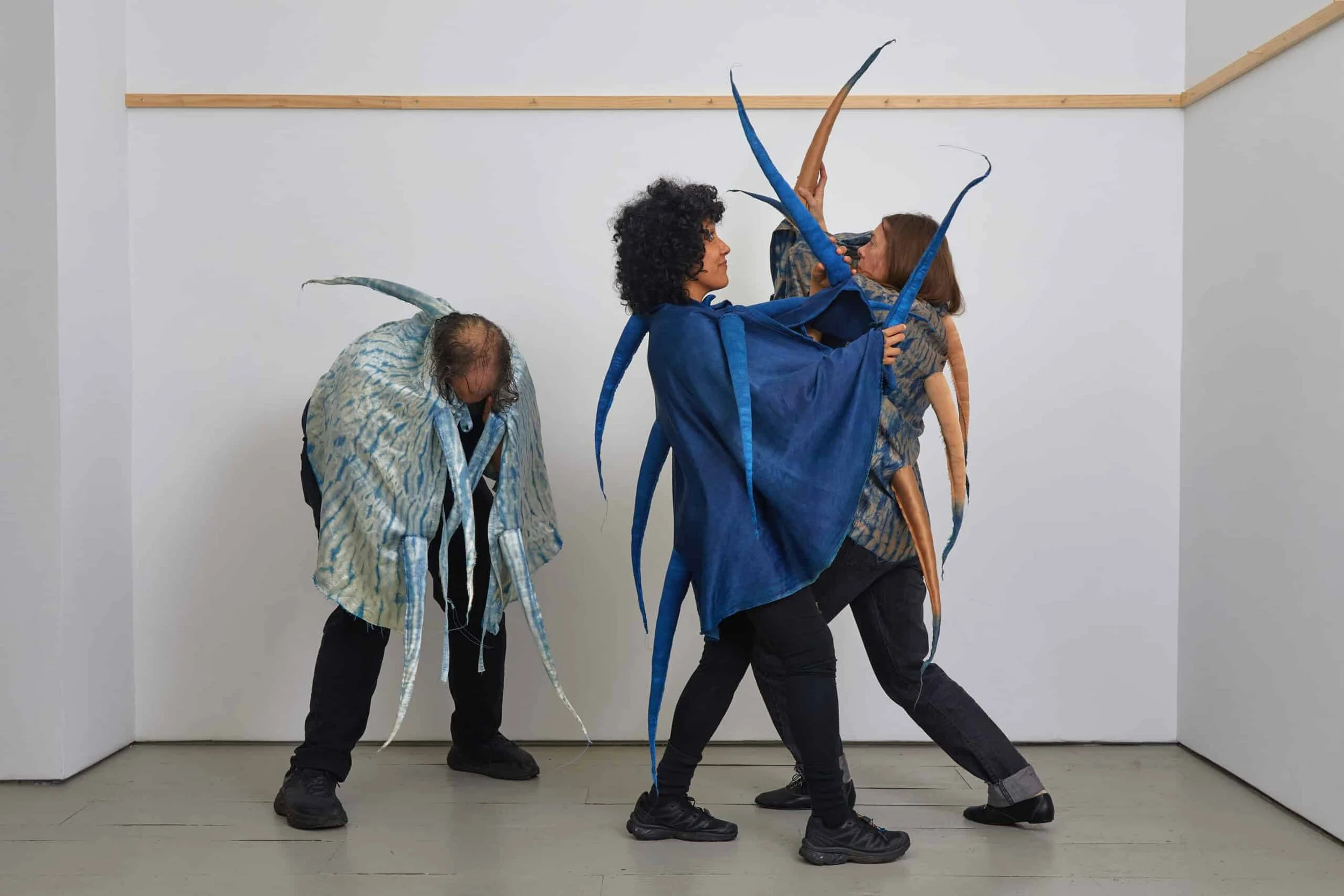
Activation with Mónica Palma, Michael Mahalchick, and Joy Curtis (2026) Horns, Holes, Skins and Branches at Klaus von Nichtssagend Gallery New York, NY
Most profoundly, Horns, Holes, Skins and Branches resonates with Kripal’s notion of reimagining the human as “more-than-human.” Curtis’ hybrid beings and erotic mutations rehearse and propose freedom from colonial categorization. Reality may be stranger, more animate, and more sacred than rational disenchantment has allowed us to perceive. Horns, Holes, Skins and Branches underscores that identity is porous, consciousness is relational, and embodiment is a process of unfolding recollection.
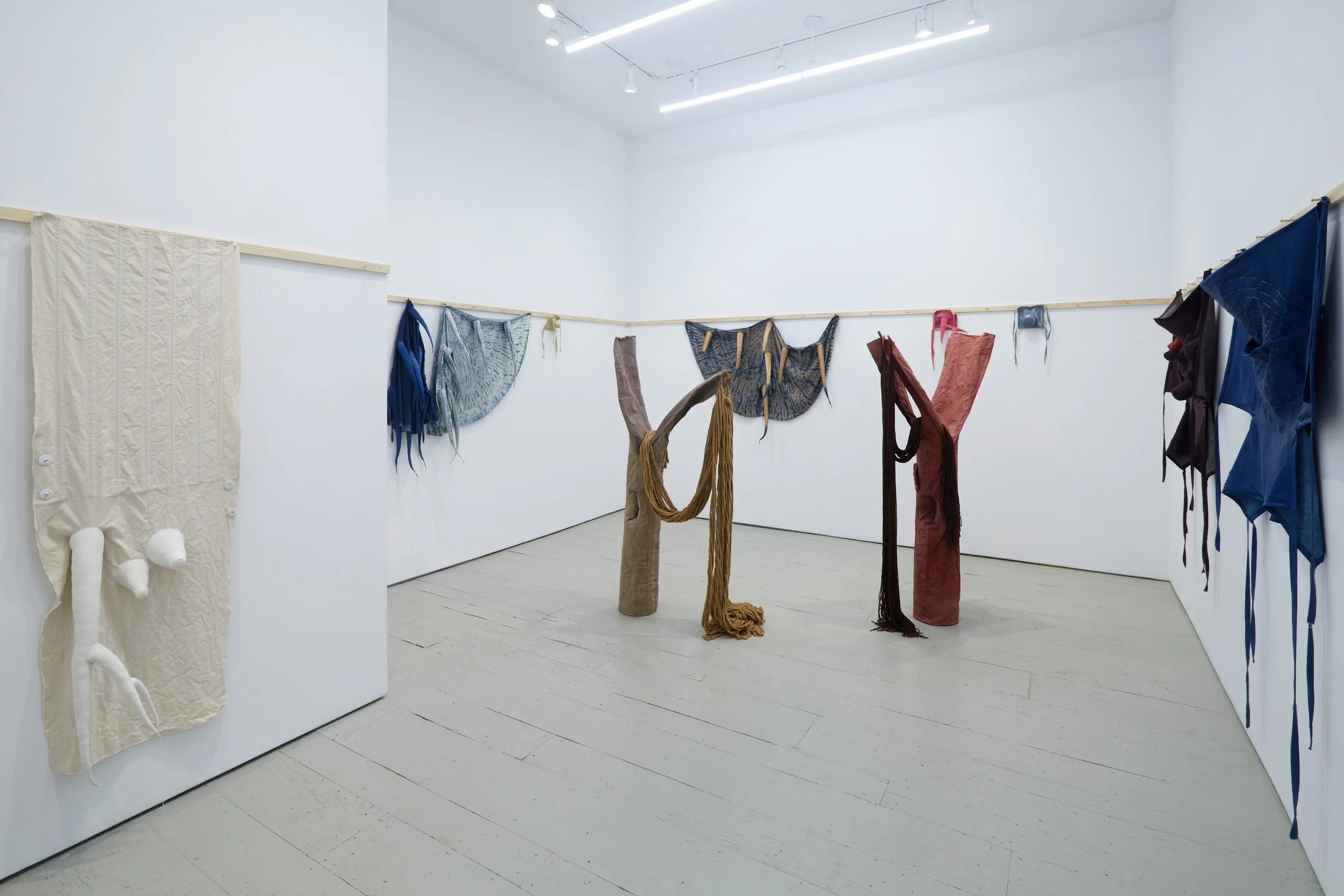
Installation view of Horns, Holes, Skins and Branches at Klaus von Nichtssagend Gallery New York, NY
Joy Curtis: Horns, Holes, Skins and Branches at Klaus von Nichtssagend Gallery (87 Franklin Street New York, NY 10013) through May 9th.